
I haven't done time series prediction before. I am currently investigating neural process.
\n\nI was wondering if neural process is a good approach for this task given the vast amount of data.\nIf it is valid, i will make a start kit some time later (after completing other 2 kaggle competitions)
\n\nPlease feel free to share your thoughts. Thanks!
", "messages": [ { "id": "653321", "postDate": "10/20/2019 08:34:28", "content": "I haven't done time series prediction before. I am currently investigating neural process.
\n\nI was wondering if neural process is a good approach for this task given the vast amount of data.\nIf it is valid, i will make a start kit some time later (after completing other 2 kaggle competitions)
\n\nPlease feel free to share your thoughts. Thanks!
", "rawMarkdown": "I haven't done time series prediction before. I am currently investigating neural process.\n\nI was wondering if neural process is a good approach for this task given the vast amount of data.\nIf it is valid, i will make a start kit some time later (after completing other 2 kaggle competitions) \n\nPlease feel free to share your thoughts. Thanks!", "votes": null }, { "id": "653399", "postDate": "10/20/2019 11:56:22", "content": "https://www.kaggle.com/c/web-traffic-time-series-forecasting/discussion/43795
\n\nhttps://www.kaggle.com/c/web-traffic-time-series-forecasting/discussion/39370
\n\nWith great github repos (the second one served as reference for winning solutions on other competitions )
", "rawMarkdown": "https://www.kaggle.com/c/web-traffic-time-series-forecasting/discussion/43795\n\nhttps://www.kaggle.com/c/web-traffic-time-series-forecasting/discussion/39370\n\nWith great github repos (the second one served as reference for winning solutions on other competitions )", "votes": null }, { "id": "653948", "postDate": "10/21/2019 07:50:58", "content": "i suppose the deep network framework is like this?
\n\n

not sure if \"forward-backward translation\" would work ????
", "rawMarkdown": "\n\n\nnot sure if \"forward-backward translation\" would work ????", "votes": null }, { "id": "653961", "postDate": "10/21/2019 08:20:57", "content": "predict the bounds too (for post processing, etc)
\n\n
useful
\n\nEnergy Basics Part 2 -- The Baseline Model\nhttps://www.youtube.com/watch?v=R7zo6SwDwis
\n\nEnergy Basics Part 3 -- Energy Performance Tracking\nhttps://www.youtube.com/watch?v=Xny7OjCiCtU
", "rawMarkdown": "useful\n\nEnergy Basics Part 2 -- The Baseline Model\nhttps://www.youtube.com/watch?v=R7zo6SwDwis\n\n\nEnergy Basics Part 3 -- Energy Performance Tracking\nhttps://www.youtube.com/watch?v=Xny7OjCiCtU", "votes": null }, { "id": "654106", "postDate": "10/21/2019 13:07:23", "content": "http://www.ibpsa.org/proceedings/BS2017/BS2017_142.pdf\nhttp://cs109-energy.github.io/\nhttp://harvardcgbc.org/cgbc-launches-online-gaussian-processes-forecasting-tool-to-analyze-building-energy-consumption/
\n\n\"Existing tools normalize energy consumption by weather using simple regression methods, while the center utilizes machine learning with the Gaussian process which requires fewer training data points and higher prediction accuracy compared to other machine learning techniques. \"
\n\nbut i think link is dead :(\n
demo video: https://www.youtube.com/watch?v=NkETYwz81W8&feature=youtu.be
", "rawMarkdown": "http://www.ibpsa.org/proceedings/BS2017/BS2017_142.pdf\nhttp://cs109-energy.github.io/\nhttp://harvardcgbc.org/cgbc-launches-online-gaussian-processes-forecasting-tool-to-analyze-building-energy-consumption/\n\n\"Existing tools normalize energy consumption by weather using simple regression methods, while the center utilizes machine learning with the Gaussian process which requires fewer training data points and higher prediction accuracy compared to other machine learning techniques. \"\n\n\nbut i think link is dead :(\n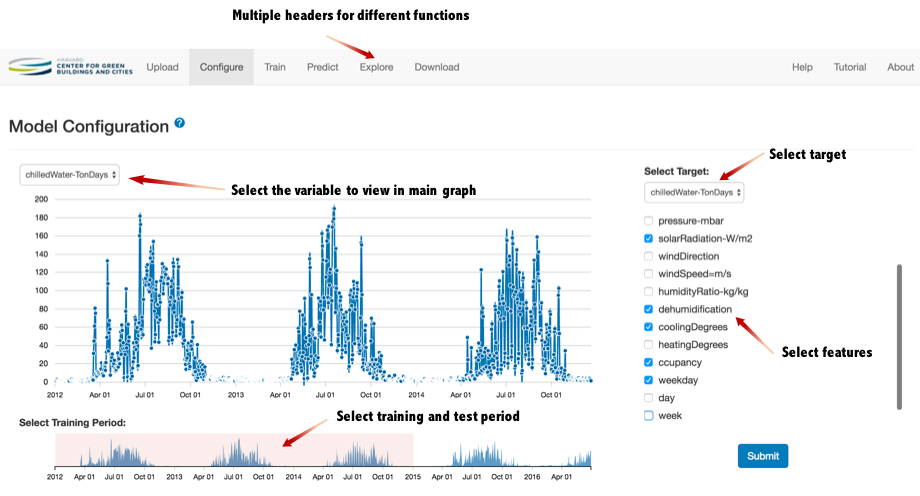\n\n\ndemo video: https://www.youtube.com/watch?v=NkETYwz81W8&feature=youtu.be", "votes": null }, { "id": "654938", "postDate": "10/22/2019 14:06:14", "content": "LSTM solution
\n\nhttps://oar.a-star.edu.sg/jspui/bitstream/123456789/2386/3/ADMA_62.pdf\n\"PowerLSTM: Power Demand Forecasting Using Long Short-Term Memory Neural Network\"
\n\n \n
 \n

Thanks a lot for sharing. Will be following your work.
", "rawMarkdown": "Thanks a lot for sharing. Will be following your work.", "votes": null }, { "id": "697826", "postDate": "12/18/2019 13:19:12", "content": "Well I am new to data science and neural networks. I formed a keras model, having 5 layers with 512 nodes (relu activation, normal initialization) and 1 layer each as input and output. Trained the model multiple times (used adam optimizer, mae loss, 500+ epochs with 5 to 6 digit batch size) and it achieved 1.216 RMSLE in the submission. I used following notebook for feature engineering (the author achieved 1.08 using GBM that too without leaks!!): https://www.kaggle.com/aitude/ashrae-kfold-lightgbm-without-leak-1-08
\n\nI think Heng's idea of considering time series feature and using sequence models like LSTM is a good one.
\n\nI'd like to know which NN architecture could achieve better result. Anyone tried LSTM or any sequence models?
", "rawMarkdown": "Well I am new to data science and neural networks. I formed a keras model, having 5 layers with 512 nodes (relu activation, normal initialization) and 1 layer each as input and output. Trained the model multiple times (used adam optimizer, mae loss, 500+ epochs with 5 to 6 digit batch size) and it achieved 1.216 RMSLE in the submission. I used following notebook for feature engineering (the author achieved 1.08 using GBM that too without leaks!!): [https://www.kaggle.com/aitude/ashrae-kfold-lightgbm-without-leak-1-08](https://www.kaggle.com/aitude/ashrae-kfold-lightgbm-without-leak-1-08)\n\nI think Heng's idea of considering time series feature and using sequence models like LSTM is a good one.\n\nI'd like to know which NN architecture could achieve better result. Anyone tried LSTM or any sequence models?", "votes": null } ], "comments": [ { "id": 653399, "author_name": "serigne", "author_url": "", "post_date": "10/20/2019 11:56:22", "content": "https://www.kaggle.com/c/web-traffic-time-series-forecasting/discussion/43795
\n\nhttps://www.kaggle.com/c/web-traffic-time-series-forecasting/discussion/39370
\n\nWith great github repos (the second one served as reference for winning solutions on other competitions )
", "votes": null, "replies": [] }, { "id": 653948, "author_name": "hengck23", "author_url": "", "post_date": "10/21/2019 07:50:58", "content": "i suppose the deep network framework is like this?
\n\n
not sure if \"forward-backward translation\" would work ????
", "votes": null, "replies": [] }, { "id": 653961, "author_name": "hengck23", "author_url": "", "post_date": "10/21/2019 08:20:57", "content": "predict the bounds too (for post processing, etc)
\n\n
useful
\n\nEnergy Basics Part 2 -- The Baseline Model\nhttps://www.youtube.com/watch?v=R7zo6SwDwis
\n\nEnergy Basics Part 3 -- Energy Performance Tracking\nhttps://www.youtube.com/watch?v=Xny7OjCiCtU
", "votes": null, "replies": [] }, { "id": 654106, "author_name": "hengck23", "author_url": "", "post_date": "10/21/2019 13:07:23", "content": "http://www.ibpsa.org/proceedings/BS2017/BS2017_142.pdf\nhttp://cs109-energy.github.io/\nhttp://harvardcgbc.org/cgbc-launches-online-gaussian-processes-forecasting-tool-to-analyze-building-energy-consumption/
\n\n\"Existing tools normalize energy consumption by weather using simple regression methods, while the center utilizes machine learning with the Gaussian process which requires fewer training data points and higher prediction accuracy compared to other machine learning techniques. \"
\n\nbut i think link is dead :(\n
demo video: https://www.youtube.com/watch?v=NkETYwz81W8&feature=youtu.be
", "votes": null, "replies": [] }, { "id": 654938, "author_name": "hengck23", "author_url": "", "post_date": "10/22/2019 14:06:14", "content": "LSTM solution
\n\nhttps://oar.a-star.edu.sg/jspui/bitstream/123456789/2386/3/ADMA_62.pdf\n\"PowerLSTM: Power Demand Forecasting Using Long Short-Term Memory Neural Network\"
\n\n\n\n
Thanks a lot for sharing. Will be following your work.
", "votes": null, "replies": [] }, { "id": 697826, "author_name": "meer93", "author_url": "", "post_date": "12/18/2019 13:19:12", "content": "Well I am new to data science and neural networks. I formed a keras model, having 5 layers with 512 nodes (relu activation, normal initialization) and 1 layer each as input and output. Trained the model multiple times (used adam optimizer, mae loss, 500+ epochs with 5 to 6 digit batch size) and it achieved 1.216 RMSLE in the submission. I used following notebook for feature engineering (the author achieved 1.08 using GBM that too without leaks!!): https://www.kaggle.com/aitude/ashrae-kfold-lightgbm-without-leak-1-08
\n\nI think Heng's idea of considering time series feature and using sequence models like LSTM is a good one.
\n\nI'd like to know which NN architecture could achieve better result. Anyone tried LSTM or any sequence models?
", "votes": null, "replies": [] } ], "raw_markdown_by_id": { "653321": "I haven't done time series prediction before. I am currently investigating neural process.\n\nI was wondering if neural process is a good approach for this task given the vast amount of data.\nIf it is valid, i will make a start kit some time later (after completing other 2 kaggle competitions) \n\nPlease feel free to share your thoughts. Thanks!", "653399": "https://www.kaggle.com/c/web-traffic-time-series-forecasting/discussion/43795\n\nhttps://www.kaggle.com/c/web-traffic-time-series-forecasting/discussion/39370\n\nWith great github repos (the second one served as reference for winning solutions on other competitions )", "653948": "i suppose the deep network framework is like this?\n\n", "653953": "\n\n\nnot sure if \"forward-backward translation\" would work ????", "653961": "predict the bounds too (for post processing, etc)\n\n", "654093": "useful\n\nEnergy Basics Part 2 -- The Baseline Model\nhttps://www.youtube.com/watch?v=R7zo6SwDwis\n\n\nEnergy Basics Part 3 -- Energy Performance Tracking\nhttps://www.youtube.com/watch?v=Xny7OjCiCtU", "654106": "http://www.ibpsa.org/proceedings/BS2017/BS2017_142.pdf\nhttp://cs109-energy.github.io/\nhttp://harvardcgbc.org/cgbc-launches-online-gaussian-processes-forecasting-tool-to-analyze-building-energy-consumption/\n\n\"Existing tools normalize energy consumption by weather using simple regression methods, while the center utilizes machine learning with the Gaussian process which requires fewer training data points and higher prediction accuracy compared to other machine learning techniques. \"\n\n\nbut i think link is dead :(\n\n\n\ndemo video: https://www.youtube.com/watch?v=NkETYwz81W8&feature=youtu.be", "654938": "LSTM solution\n\nhttps://oar.a-star.edu.sg/jspui/bitstream/123456789/2386/3/ADMA_62.pdf\n\"PowerLSTM: Power Demand Forecasting Using Long Short-Term Memory Neural Network\"\n\n\n\n", "660054": "Thanks a lot for sharing. Will be following your work.", "697826": "Well I am new to data science and neural networks. I formed a keras model, having 5 layers with 512 nodes (relu activation, normal initialization) and 1 layer each as input and output. Trained the model multiple times (used adam optimizer, mae loss, 500+ epochs with 5 to 6 digit batch size) and it achieved 1.216 RMSLE in the submission. I used following notebook for feature engineering (the author achieved 1.08 using GBM that too without leaks!!): [https://www.kaggle.com/aitude/ashrae-kfold-lightgbm-without-leak-1-08](https://www.kaggle.com/aitude/ashrae-kfold-lightgbm-without-leak-1-08)\n\nI think Heng's idea of considering time series feature and using sequence models like LSTM is a good one.\n\nI'd like to know which NN architecture could achieve better result. Anyone tried LSTM or any sequence models?" }, "source": "meta" }