 \nThe results are promising , but it is still in development. So many of the features we need are not implemented yet. There will be small control over tuning the model.
NGBoost, Natural Gradient Boosting for Probabilistic Prediction, is a New Boosting algorithm from Stanford ML Group, whose paper was published on 9-oct-2019.\nhttps://arxiv.org/abs/1910.03225\nLets explore it in this competition and see how does it perform in comparison to LightGBM, XGBoost and CatBoost.
\n\nhttps://stanfordmlgroup.github.io/projects/ngboost/\nhttps://towardsdatascience.com/ngboost-explained-comparison-to-lightgbm-and-xgboost-fda510903e53
", "messages": [ { "id": "662115", "postDate": "10/31/2019 05:19:28", "content": "NGBoost, Natural Gradient Boosting for Probabilistic Prediction, is a New Boosting algorithm from Stanford ML Group, whose paper was published on 9-oct-2019.\nhttps://arxiv.org/abs/1910.03225\nLets explore it in this competition and see how does it perform in comparison to LightGBM, XGBoost and CatBoost.
\n\nhttps://stanfordmlgroup.github.io/projects/ngboost/\nhttps://towardsdatascience.com/ngboost-explained-comparison-to-lightgbm-and-xgboost-fda510903e53
", "rawMarkdown": "NGBoost, Natural Gradient Boosting for Probabilistic Prediction, is a New Boosting algorithm from Stanford ML Group, whose paper was published on 9-oct-2019.\nhttps://arxiv.org/abs/1910.03225\nLets explore it in this competition and see how does it perform in comparison to LightGBM, XGBoost and CatBoost.\n\nhttps://stanfordmlgroup.github.io/projects/ngboost/\nhttps://towardsdatascience.com/ngboost-explained-comparison-to-lightgbm-and-xgboost-fda510903e53", "votes": null }, { "id": "662145", "postDate": "10/31/2019 06:12:10", "content": "\nThe results are promising , but it is still in development. So many of the features we need are not implemented yet. There will be small control over tuning the model.
Will it be the new XgBoost ?
", "rawMarkdown": "Will it be the new XgBoost ?", "votes": null }, { "id": "662689", "postDate": "10/31/2019 21:32:03", "content": "I just tried that in another competition several days ago, and the performance is mmm... \nWe'd better not expect too much from a new coming library 👀
", "rawMarkdown": "I just tried that in another competition several days ago, and the performance is mmm... \nWe'd better not expect too much from a new coming library 👀", "votes": null }, { "id": "662714", "postDate": "10/31/2019 22:29:32", "content": "We’ll wait and see next future...
", "rawMarkdown": "We’ll wait and see next future...", "votes": null }, { "id": "663327", "postDate": "11/01/2019 20:08:22", "content": "Yes, its looks very promising! Haven't seen many public Kaggle kernels yet using it, expect for this kernel.
", "rawMarkdown": "Yes, its looks very promising! Haven't seen many public Kaggle kernels yet using it, expect for [this kernel](https://www.kaggle.com/s903124/ngboost-for-nfl-data).", "votes": null }, { "id": "663328", "postDate": "11/01/2019 20:09:10", "content": "Hmm ok, thanks for letting us know. Our team will experiment with it and maybe publish a public kernel using it.
", "rawMarkdown": "Hmm ok, thanks for letting us know. Our team will experiment with it and maybe publish a public kernel using it.", "votes": null }, { "id": "663364", "postDate": "11/01/2019 21:50:39", "content": "As far as I understand the focus is on providing uncertainties for the predictions, so it could be useful in some contexts even if the performances are not the same as the usual boosting libraries
", "rawMarkdown": "As far as I understand the focus is on providing uncertainties for the predictions, so it could be useful in some contexts even if the performances are not the same as the usual boosting libraries", "votes": null }, { "id": "663432", "postDate": "11/02/2019 02:13:49", "content": "I quickly read the paper(I am not an expert however.) It approximates distributions in which the expectation of targets are the highest. Using proper scoring rule(for example MLE or CRPS), It gradually/sequentially update parameters and scalings for each targets and each base learners by small change in divergence between after update and before update in such a way that it maximize scoring rule. That is what I understood.(It might be not exactly correct :P)
", "rawMarkdown": "I quickly read the paper(I am not an expert however.) It approximates distributions in which the expectation of targets are the highest. Using proper scoring rule(for example MLE or CRPS), It gradually/sequentially update parameters and scalings for each targets and each base learners by small change in divergence between after update and before update in such a way that it maximize scoring rule. That is what I understood.(It might be not exactly correct :P)", "votes": null }, { "id": "663657", "postDate": "11/02/2019 13:12:30", "content": "look amazing, I will look the paper. Thanks for the information.
", "rawMarkdown": "look amazing, I will look the paper. Thanks for the information.", "votes": null }, { "id": "663826", "postDate": "11/02/2019 17:56:36", "content": "Maybe good for the NFL contest
", "rawMarkdown": "Maybe good for the NFL contest", "votes": null }, { "id": "664067", "postDate": "11/03/2019 05:41:41", "content": "I will try NGBoost in the next comp and see the results.
", "rawMarkdown": "I will try NGBoost in the next comp and see the results.", "votes": null } ], "comments": [ { "id": 662145, "author_name": "khairulislam", "author_url": "", "post_date": "10/31/2019 06:12:10", "content": "\nThe results are promising , but it is still in development. So many of the features we need are not implemented yet. There will be small control over tuning the model.
Will it be the new XgBoost ?
", "votes": null, "replies": [] }, { "id": 662689, "author_name": "jielu0728", "author_url": "", "post_date": "10/31/2019 21:32:03", "content": "I just tried that in another competition several days ago, and the performance is mmm... \nWe'd better not expect too much from a new coming library 👀
", "votes": null, "replies": [ { "id": 662714, "author_name": "pfichou", "author_url": "", "post_date": "10/31/2019 22:29:32", "content": "We’ll wait and see next future...
", "votes": null, "replies": [] }, { "id": 663328, "author_name": "carlolepelaars", "author_url": "", "post_date": "11/01/2019 20:09:10", "content": "Hmm ok, thanks for letting us know. Our team will experiment with it and maybe publish a public kernel using it.
", "votes": null, "replies": [] }, { "id": 663364, "author_name": "stecasasso", "author_url": "", "post_date": "11/01/2019 21:50:39", "content": "As far as I understand the focus is on providing uncertainties for the predictions, so it could be useful in some contexts even if the performances are not the same as the usual boosting libraries
", "votes": null, "replies": [] }, { "id": 663432, "author_name": "hanjoonchoe", "author_url": "", "post_date": "11/02/2019 02:13:49", "content": "I quickly read the paper(I am not an expert however.) It approximates distributions in which the expectation of targets are the highest. Using proper scoring rule(for example MLE or CRPS), It gradually/sequentially update parameters and scalings for each targets and each base learners by small change in divergence between after update and before update in such a way that it maximize scoring rule. That is what I understood.(It might be not exactly correct :P)
", "votes": null, "replies": [] } ] }, { "id": 663327, "author_name": "carlolepelaars", "author_url": "", "post_date": "11/01/2019 20:08:22", "content": "Yes, its looks very promising! Haven't seen many public Kaggle kernels yet using it, expect for this kernel.
", "votes": null, "replies": [] }, { "id": 663657, "author_name": "rvillalongar", "author_url": "", "post_date": "11/02/2019 13:12:30", "content": "look amazing, I will look the paper. Thanks for the information.
", "votes": null, "replies": [] }, { "id": 663826, "author_name": "manupandit", "author_url": "", "post_date": "11/02/2019 17:56:36", "content": "Maybe good for the NFL contest
", "votes": null, "replies": [] }, { "id": 664067, "author_name": "prashant111", "author_url": "", "post_date": "11/03/2019 05:41:41", "content": "I will try NGBoost in the next comp and see the results.
", "votes": null, "replies": [] } ], "raw_markdown_by_id": { "662115": "NGBoost, Natural Gradient Boosting for Probabilistic Prediction, is a New Boosting algorithm from Stanford ML Group, whose paper was published on 9-oct-2019.\nhttps://arxiv.org/abs/1910.03225\nLets explore it in this competition and see how does it perform in comparison to LightGBM, XGBoost and CatBoost.\n\nhttps://stanfordmlgroup.github.io/projects/ngboost/\nhttps://towardsdatascience.com/ngboost-explained-comparison-to-lightgbm-and-xgboost-fda510903e53", "662145": "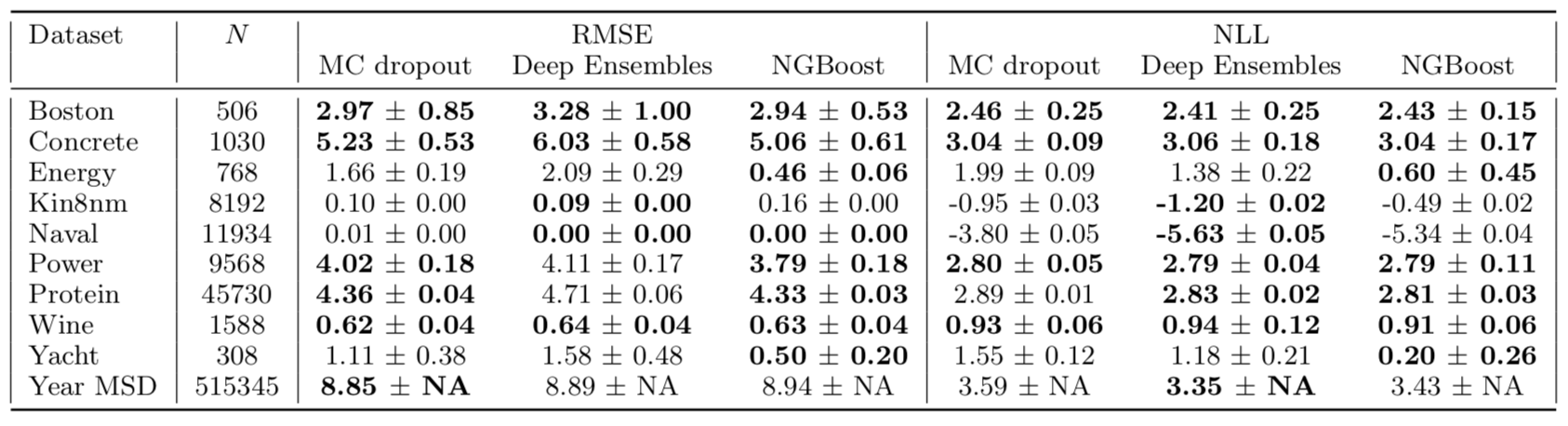\nThe results are promising , but it is still in development. So many of the features we need are not implemented yet. There will be small control over tuning the model.", "662662": "Will it be the new XgBoost ?", "662689": "I just tried that in another competition several days ago, and the performance is mmm... \nWe'd better not expect too much from a new coming library 👀", "662714": "We’ll wait and see next future...", "663327": "Yes, its looks very promising! Haven't seen many public Kaggle kernels yet using it, expect for [this kernel](https://www.kaggle.com/s903124/ngboost-for-nfl-data).", "663328": "Hmm ok, thanks for letting us know. Our team will experiment with it and maybe publish a public kernel using it.", "663364": "As far as I understand the focus is on providing uncertainties for the predictions, so it could be useful in some contexts even if the performances are not the same as the usual boosting libraries", "663432": "I quickly read the paper(I am not an expert however.) It approximates distributions in which the expectation of targets are the highest. Using proper scoring rule(for example MLE or CRPS), It gradually/sequentially update parameters and scalings for each targets and each base learners by small change in divergence between after update and before update in such a way that it maximize scoring rule. That is what I understood.(It might be not exactly correct :P)", "663657": "look amazing, I will look the paper. Thanks for the information.", "663826": "Maybe good for the NFL contest", "664067": "I will try NGBoost in the next comp and see the results." }, "source": "meta" }