
it is mentioned that \"Using state-of-the-art methods from quantum mechanics, it is possible to accurately calculate scalar coupling constants given only a 3D molecular structure as input. However, these quantum mechanics calculations are extremely expensive (days or weeks per molecule), and therefore have limited applicability in day-to-day workflows.\"
\n\nWhat can i find the theoretical equation/solution or more information on this? thanks!
", "messages": [ { "id": 540260, "postDate": "2019-05-31T08:44:16.797Z", "content": "it is mentioned that \"Using state-of-the-art methods from quantum mechanics, it is possible to accurately calculate scalar coupling constants given only a 3D molecular structure as input. However, these quantum mechanics calculations are extremely expensive (days or weeks per molecule), and therefore have limited applicability in day-to-day workflows.\"
\n\nWhat can i find the theoretical equation/solution or more information on this? thanks!
", "rawMarkdown": "it is mentioned that \"Using state-of-the-art methods from quantum mechanics, it is possible to accurately calculate scalar coupling constants given only a 3D molecular structure as input. However, these quantum mechanics calculations are extremely expensive (days or weeks per molecule), and therefore have limited applicability in day-to-day workflows.\"\n\nWhat can i find the theoretical equation/solution or more information on this? thanks!\n\n", "votes": 35 }, { "id": 540415, "postDate": "2019-05-31T13:24:32.477Z", "content": "If you look up density-functional theory (often just called DFT), this should get you started. I believe that's how the 'ground truth' was calculated for the dataset. Just a heads up though, using quantum mechanical calculations themselves are against the competition rules.
", "rawMarkdown": "If you look up density-functional theory (often just called DFT), this should get you started. I believe that's how the 'ground truth' was calculated for the dataset. Just a heads up though, using quantum mechanical calculations themselves are against the competition rules.", "votes": 7, "replies": [ { "id": 540945, "postDate": "2019-06-01T12:13:52.043Z", "content": "It's probably a method more accurate than DFT. DFT would take seconds on small molecules like that. I guess it's quantum mechanical methods based on coupled clusters (CCSD and CCSD(T)), that is, a many body resolution of the Schrodinger equation.
", "rawMarkdown": "It's probably a method more accurate than DFT. DFT would take seconds on small molecules like that. I guess it's quantum mechanical methods based on coupled clusters (CCSD and CCSD(T)), that is, a many body resolution of the Schrodinger equation." }, { "id": 541152, "postDate": "2019-06-01T22:13:10.617Z", "content": "It is DFT that is used to calculate J-couplings and it doesn't take seconds... https://aip.scitation.org/doi/10.1063/1.2801984\nQMM would be faster, I would have thought.
", "rawMarkdown": "It is DFT that is used to calculate J-couplings and it doesn't take seconds... https://aip.scitation.org/doi/10.1063/1.2801984\nQMM would be faster, I would have thought." } ] }, { "id": 558688, "postDate": "2019-06-22T18:34:24.473Z", "content": "Bypassing the Kohn-Sham equations with machine learning
\n\nhttps://www.nature.com/articles/s41467-017-00839-3\nhttps://syncedreview.com/2017/03/30/hey-computer-what-if-i-dont-want-to-solve-my-schrodinger-equation/\nhttps://arxiv.org/pdf/1807.07014.pdf
\n\n
What factors affect coupling constants?
\n\nAnswer:\nThe major factors affecting coupling constants are dihedral angles, substituents, hybridization, and ring strain.
\n\n...
\n\nhttps://socratic.org/questions/what-factors-affect-coupling-constants
\n\nhttps://ekwan.github.io/pdfs/nmr/lecture%203.pdf
", "rawMarkdown": "What factors affect coupling constants?\n\nAnswer:\nThe major factors affecting coupling constants are dihedral angles, substituents, hybridization, and ring strain.\n\n...\n\nhttps://socratic.org/questions/what-factors-affect-coupling-constants\n\nhttps://ekwan.github.io/pdfs/nmr/lecture%203.pdf", "votes": 4 }, { "id": 558696, "postDate": "2019-06-22T18:42:57.493Z", "content": "SchNetPack: A Deep Learning Toolbox For Atomistic Systems
\n\nhttps://arxiv.org/pdf/1809.01072.pdf
\n\nweighted ACSFs
", "rawMarkdown": "SchNetPack: A Deep Learning Toolbox For Atomistic Systems\n\nhttps://arxiv.org/pdf/1809.01072.pdf\n\nweighted ACSFs", "votes": 1, "replies": [ { "id": 558712, "postDate": "2019-06-22T19:07:27.073Z", "content": "Nice find! We'll have to watch out for folks using this to call ASE which can access a wide range of DFT calculators... https://wiki.fysik.dtu.dk/ase/py-modindex.html
", "rawMarkdown": "Nice find! We'll have to watch out for folks using this to call ASE which can access a wide range of DFT calculators... https://wiki.fysik.dtu.dk/ase/py-modindex.html" } ] }, { "id": 541582, "postDate": "2019-06-02T17:26:04.683Z", "content": "this may be a good resource: https://www.chem.uzh.ch/dam/jcr:baf40086-d7ba-449f-9add-34b82335e90a/NMR_HS17.pdf
\n\nmaybe there are open source scalar coupling constant simulation code available
", "rawMarkdown": "this may be a good resource: https://www.chem.uzh.ch/dam/jcr:baf40086-d7ba-449f-9add-34b82335e90a/NMR_HS17.pdf\n\n\nmaybe there are open source scalar coupling constant simulation code available ", "votes": 1 }, { "id": 560054, "postDate": "2019-06-25T01:53:13.747Z", "content": "This explain very well!
\n\nhttp://personal.tcu.edu/bjanesko/NMR.htm
", "rawMarkdown": "This explain very well!\n\nhttp://personal.tcu.edu/bjanesko/NMR.htm", "votes": 2 }, { "id": 543476, "postDate": "2019-06-04T14:48:49.180Z", "content": "Hi Heng, thanks for your sharing. \nI found this paper \"MoleculeNet: A Benchmark for Molecular Machine Learning (https://arxiv.org/abs/1703.00564)\". \nMoleculeNet is part of the DeepChem.
", "rawMarkdown": "Hi Heng, thanks for your sharing. \nI found this paper \"MoleculeNet: A Benchmark for Molecular Machine Learning (https://arxiv.org/abs/1703.00564)\". \nMoleculeNet is part of the DeepChem. " }, { "id": 542401, "postDate": "2019-06-03T20:47:48.557Z", "content": "http://folk.uio.no/helgaker/talks/Fysikk_2001.pdf \nhttp://hanicka.uochb.cas.cz/~bour/pdf/JCP02836.pdf
\n\nDFT calculations of NMR indirect spin–spin coupling constants
\n\n
computational NMR, quantum chemistry programming:
\n\nhttps://people.chem.ucsb.edu/kahn/kalju/chem112L/public/nmr_split.html
\n\nhttps://www.q-chem.com/qchem-website/manual/qchem43_manual/sect-SScouplings.html
\n\n\n\nIndirect nuclear spin–spin coupling constants (also known as scalar coupling or J-coupling) can be evaluated in Q-Chem at the Hartree–Fock and density functional levels of theory[552, 553] (restricted wavefunctions only). ....
\n\nhttps://en.wikipedia.org/wiki/List_of_quantum_chemistry_and_solid-state_physics_software
\n\nhttp://images.nvidia.com/content/tesla/pdf/quantum-chemistry-may-2016-mb-slides.pdf
", "rawMarkdown": "computational NMR, quantum chemistry programming:\n\nhttps://people.chem.ucsb.edu/kahn/kalju/chem112L/public/nmr_split.html\n\nhttps://www.q-chem.com/qchem-website/manual/qchem43_manual/sect-SScouplings.html\n\nhttps://github.com/ppqm\n\n\nIndirect nuclear spin–spin coupling constants (also known as scalar coupling or J-coupling) can be evaluated in Q-Chem at the Hartree–Fock and density functional levels of theory[552, 553] (restricted wavefunctions only). ....\n\nhttps://en.wikipedia.org/wiki/List_of_quantum_chemistry_and_solid-state_physics_software\n\nhttp://images.nvidia.com/content/tesla/pdf/quantum-chemistry-may-2016-mb-slides.pdf" }, { "id": 540596, "postDate": "2019-05-31T17:46:09.847Z", "content": "https://arxiv.org/pdf/0708.3589.pdf
", "rawMarkdown": "https://arxiv.org/pdf/0708.3589.pdf" }, { "id": 540342, "postDate": "2019-05-31T11:28:20.947Z", "content": "Also, looking at the data, it looks like the 'Fermi Contact contribution' is the most important part of the scalar coupling constant? (I'm not in chemistry, someone can confirm?) Is there a way to approximate it? We now have tesla P100 gpu on kaggle...
", "rawMarkdown": "Also, looking at the data, it looks like the 'Fermi Contact contribution' is the most important part of the scalar coupling constant? (I'm not in chemistry, someone can confirm?) Is there a way to approximate it? We now have tesla P100 gpu on kaggle...", "replies": [ { "id": 540406, "postDate": "2019-05-31T13:13:39.497Z", "content": "I don't know how to approximate it but Wikipedia does:
\n\nThe interaction was first derived by Enrico Fermi in 1930.[7] A classical derivation of this term is contained in \"Classical Electrodynamics\" by J. D. Jackson.[8] In short, the classical energy may be written in terms of the energy of one magnetic dipole moment in the magnetic field B(r) of another dipole. This field acquires a simple expression when the distance r between the two dipoles goes to zero, since\nThe formula doesn't copy and paste well so you can find it here:\nhttps://en.wikipedia.org/wiki/Fermi_contact_interaction
", "rawMarkdown": "I don't know how to approximate it but Wikipedia does:\n\nThe interaction was first derived by Enrico Fermi in 1930.[7] A classical derivation of this term is contained in \"Classical Electrodynamics\" by J. D. Jackson.[8] In short, the classical energy may be written in terms of the energy of one magnetic dipole moment in the magnetic field B(r) of another dipole. This field acquires a simple expression when the distance r between the two dipoles goes to zero, since\nThe formula doesn't copy and paste well so you can find it here:\nhttps://en.wikipedia.org/wiki/Fermi_contact_interaction", "votes": 1 }, { "id": 541317, "postDate": "2019-06-02T08:12:20.287Z", "content": "The Fermi contact interaction is basically the magnetic interaction between electrons and the nucleus. It thus depends on the nuclear and electron magnetic moments. But the interaction itself my be difficult to calculate without other information, because the spins can be aligned antiparallel, or parallel, or in other strange configurations. An it also depends on the value of the electron wave-function at the nucleus, which is kind of impossible to calculate without solving the Schrodinger equation.
\n\nBut I guess we could do something with just the nuclear and electron magnetic moments.
", "rawMarkdown": "The Fermi contact interaction is basically the magnetic interaction between electrons and the nucleus. It thus depends on the nuclear and electron magnetic moments. But the interaction itself my be difficult to calculate without other information, because the spins can be aligned antiparallel, or parallel, or in other strange configurations. An it also depends on the value of the electron wave-function at the nucleus, which is kind of impossible to calculate without solving the Schrodinger equation.\n\nBut I guess we could do something with just the nuclear and electron magnetic moments.", "votes": 1 } ] }, { "id": 560579, "postDate": "2019-06-25T15:41:43.767Z", "rawMarkdown": "", "isDeleted": true } ], "comments": [ { "id": 540415, "author_name": "Matt", "author_url": "", "post_date": "2019-05-31T13:24:32.477000", "content": "If you look up density-functional theory (often just called DFT), this should get you started. I believe that's how the 'ground truth' was calculated for the dataset. Just a heads up though, using quantum mechanical calculations themselves are against the competition rules.
", "votes": 7, "replies": [ { "id": 540945, "author_name": "Boris D.", "author_url": "", "post_date": "2019-06-01T12:13:52.043000", "content": "It's probably a method more accurate than DFT. DFT would take seconds on small molecules like that. I guess it's quantum mechanical methods based on coupled clusters (CCSD and CCSD(T)), that is, a many body resolution of the Schrodinger equation.
", "votes": 0, "replies": [] }, { "id": 541152, "author_name": "phucco", "author_url": "", "post_date": "2019-06-01T22:13:10.617000", "content": "It is DFT that is used to calculate J-couplings and it doesn't take seconds... https://aip.scitation.org/doi/10.1063/1.2801984\nQMM would be faster, I would have thought.
", "votes": 0, "replies": [] } ] }, { "id": 558688, "author_name": "hengck23", "author_url": "", "post_date": "2019-06-22T18:34:24.473000", "content": "Bypassing the Kohn-Sham equations with machine learning
\n\nhttps://www.nature.com/articles/s41467-017-00839-3\nhttps://syncedreview.com/2017/03/30/hey-computer-what-if-i-dont-want-to-solve-my-schrodinger-equation/\nhttps://arxiv.org/pdf/1807.07014.pdf
\n\n
What factors affect coupling constants?
\n\nAnswer:\nThe major factors affecting coupling constants are dihedral angles, substituents, hybridization, and ring strain.
\n\n...
\n\nhttps://socratic.org/questions/what-factors-affect-coupling-constants
\n\nhttps://ekwan.github.io/pdfs/nmr/lecture%203.pdf
", "votes": 4, "replies": [] }, { "id": 558696, "author_name": "hengck23", "author_url": "", "post_date": "2019-06-22T18:42:57.493000", "content": "SchNetPack: A Deep Learning Toolbox For Atomistic Systems
\n\nhttps://arxiv.org/pdf/1809.01072.pdf
\n\nweighted ACSFs
", "votes": 1, "replies": [ { "id": 558712, "author_name": "phucco", "author_url": "", "post_date": "2019-06-22T19:07:27.073000", "content": "Nice find! We'll have to watch out for folks using this to call ASE which can access a wide range of DFT calculators... https://wiki.fysik.dtu.dk/ase/py-modindex.html
", "votes": 0, "replies": [] } ] }, { "id": 541582, "author_name": "hengck23", "author_url": "", "post_date": "2019-06-02T17:26:04.683000", "content": "this may be a good resource: https://www.chem.uzh.ch/dam/jcr:baf40086-d7ba-449f-9add-34b82335e90a/NMR_HS17.pdf
\n\nmaybe there are open source scalar coupling constant simulation code available
", "votes": 1, "replies": [] }, { "id": 560054, "author_name": "hengck23", "author_url": "", "post_date": "2019-06-25T01:53:13.747000", "content": "This explain very well!
\n\nhttp://personal.tcu.edu/bjanesko/NMR.htm
", "votes": 2, "replies": [] }, { "id": 543476, "author_name": "hd2019", "author_url": "", "post_date": "2019-06-04T14:48:49.180000", "content": "Hi Heng, thanks for your sharing. \nI found this paper \"MoleculeNet: A Benchmark for Molecular Machine Learning (https://arxiv.org/abs/1703.00564)\". \nMoleculeNet is part of the DeepChem.
", "votes": 0, "replies": [] }, { "id": 542401, "author_name": "hengck23", "author_url": "", "post_date": "2019-06-03T20:47:48.557000", "content": "http://folk.uio.no/helgaker/talks/Fysikk_2001.pdf \nhttp://hanicka.uochb.cas.cz/~bour/pdf/JCP02836.pdf
\n\nDFT calculations of NMR indirect spin–spin coupling constants
\n\n
computational NMR, quantum chemistry programming:
\n\nhttps://people.chem.ucsb.edu/kahn/kalju/chem112L/public/nmr_split.html
\n\nhttps://www.q-chem.com/qchem-website/manual/qchem43_manual/sect-SScouplings.html
\n\n\n\nIndirect nuclear spin–spin coupling constants (also known as scalar coupling or J-coupling) can be evaluated in Q-Chem at the Hartree–Fock and density functional levels of theory[552, 553] (restricted wavefunctions only). ....
\n\nhttps://en.wikipedia.org/wiki/List_of_quantum_chemistry_and_solid-state_physics_software
\n\nhttp://images.nvidia.com/content/tesla/pdf/quantum-chemistry-may-2016-mb-slides.pdf
", "votes": 0, "replies": [] }, { "id": 540596, "author_name": "phucco", "author_url": "", "post_date": "2019-05-31T17:46:09.847000", "content": "https://arxiv.org/pdf/0708.3589.pdf
", "votes": 0, "replies": [] }, { "id": 540342, "author_name": "jmtest", "author_url": "", "post_date": "2019-05-31T11:28:20.947000", "content": "Also, looking at the data, it looks like the 'Fermi Contact contribution' is the most important part of the scalar coupling constant? (I'm not in chemistry, someone can confirm?) Is there a way to approximate it? We now have tesla P100 gpu on kaggle...
", "votes": 0, "replies": [ { "id": 540406, "author_name": "Kyle Peters", "author_url": "", "post_date": "2019-05-31T13:13:39.497000", "content": "I don't know how to approximate it but Wikipedia does:
\n\nThe interaction was first derived by Enrico Fermi in 1930.[7] A classical derivation of this term is contained in \"Classical Electrodynamics\" by J. D. Jackson.[8] In short, the classical energy may be written in terms of the energy of one magnetic dipole moment in the magnetic field B(r) of another dipole. This field acquires a simple expression when the distance r between the two dipoles goes to zero, since\nThe formula doesn't copy and paste well so you can find it here:\nhttps://en.wikipedia.org/wiki/Fermi_contact_interaction
", "votes": 1, "replies": [] }, { "id": 541317, "author_name": "Boris D.", "author_url": "", "post_date": "2019-06-02T08:12:20.287000", "content": "The Fermi contact interaction is basically the magnetic interaction between electrons and the nucleus. It thus depends on the nuclear and electron magnetic moments. But the interaction itself my be difficult to calculate without other information, because the spins can be aligned antiparallel, or parallel, or in other strange configurations. An it also depends on the value of the electron wave-function at the nucleus, which is kind of impossible to calculate without solving the Schrodinger equation.
\n\nBut I guess we could do something with just the nuclear and electron magnetic moments.
", "votes": 1, "replies": [] } ] }, { "id": 560579, "author_name": "", "author_url": "", "post_date": "2019-06-25T15:41:43.767000", "content": "", "votes": 0, "replies": [] } ], "raw_markdown_by_id": { "540260": "it is mentioned that \"Using state-of-the-art methods from quantum mechanics, it is possible to accurately calculate scalar coupling constants given only a 3D molecular structure as input. However, these quantum mechanics calculations are extremely expensive (days or weeks per molecule), and therefore have limited applicability in day-to-day workflows.\"\n\nWhat can i find the theoretical equation/solution or more information on this? thanks!\n\n", "540415": "If you look up density-functional theory (often just called DFT), this should get you started. I believe that's how the 'ground truth' was calculated for the dataset. Just a heads up though, using quantum mechanical calculations themselves are against the competition rules.", "558688": "Bypassing the Kohn-Sham equations with machine learning\n\nhttps://www.nature.com/articles/s41467-017-00839-3\nhttps://syncedreview.com/2017/03/30/hey-computer-what-if-i-dont-want-to-solve-my-schrodinger-equation/\nhttps://arxiv.org/pdf/1807.07014.pdf\n\n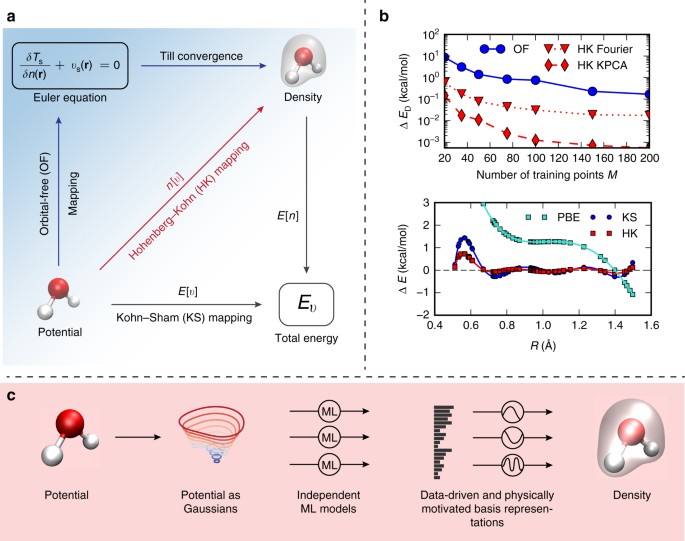", "560656": "What factors affect coupling constants?\n\nAnswer:\nThe major factors affecting coupling constants are dihedral angles, substituents, hybridization, and ring strain.\n\n...\n\nhttps://socratic.org/questions/what-factors-affect-coupling-constants\n\nhttps://ekwan.github.io/pdfs/nmr/lecture%203.pdf", "558696": "SchNetPack: A Deep Learning Toolbox For Atomistic Systems\n\nhttps://arxiv.org/pdf/1809.01072.pdf\n\nweighted ACSFs", "541582": "this may be a good resource: https://www.chem.uzh.ch/dam/jcr:baf40086-d7ba-449f-9add-34b82335e90a/NMR_HS17.pdf\n\n\nmaybe there are open source scalar coupling constant simulation code available ", "560054": "This explain very well!\n\nhttp://personal.tcu.edu/bjanesko/NMR.htm", "543476": "Hi Heng, thanks for your sharing. \nI found this paper \"MoleculeNet: A Benchmark for Molecular Machine Learning (https://arxiv.org/abs/1703.00564)\". \nMoleculeNet is part of the DeepChem. ", "542401": "http://folk.uio.no/helgaker/talks/Fysikk_2001.pdf \nhttp://hanicka.uochb.cas.cz/~bour/pdf/JCP02836.pdf\n\nDFT calculations of NMR indirect spin–spin coupling constants \n\n", "542385": "computational NMR, quantum chemistry programming:\n\nhttps://people.chem.ucsb.edu/kahn/kalju/chem112L/public/nmr_split.html\n\nhttps://www.q-chem.com/qchem-website/manual/qchem43_manual/sect-SScouplings.html\n\nhttps://github.com/ppqm\n\n\nIndirect nuclear spin–spin coupling constants (also known as scalar coupling or J-coupling) can be evaluated in Q-Chem at the Hartree–Fock and density functional levels of theory[552, 553] (restricted wavefunctions only). ....\n\nhttps://en.wikipedia.org/wiki/List_of_quantum_chemistry_and_solid-state_physics_software\n\nhttp://images.nvidia.com/content/tesla/pdf/quantum-chemistry-may-2016-mb-slides.pdf", "540596": "https://arxiv.org/pdf/0708.3589.pdf", "540342": "Also, looking at the data, it looks like the 'Fermi Contact contribution' is the most important part of the scalar coupling constant? (I'm not in chemistry, someone can confirm?) Is there a way to approximate it? We now have tesla P100 gpu on kaggle...", "560579": "" } }