
I was playing with graphs and got this interesting result :)\n
I was playing with graphs and got this interesting result :)\n
Hi Andrew. Could you explain the graph?
", "rawMarkdown": "Hi Andrew. Could you explain the graph?", "votes": null }, { "id": "557744", "postDate": "06/21/2019 12:43:17", "content": "That's methane. You have five atoms (one carbon, four hydrogens) all coupled to each other in a pairwise manner. What other graph can there be?:)
", "rawMarkdown": "That's methane. You have five atoms (one carbon, four hydrogens) all coupled to each other in a pairwise manner. What other graph can there be?:)", "votes": null }, { "id": "557770", "postDate": "06/21/2019 13:02:47", "content": "The graph takes atom indices as nodes and tries to build a reasonable representation using dist as value to draw the edges.
Yeah! But I really liked how it looks like :)
", "rawMarkdown": "Yeah! But I really liked how it looks like :)", "votes": null }, { "id": "557794", "postDate": "06/21/2019 13:21:55", "content": "Sorry, couldn't help it\n
Looks great but it does not look like CH4. The representation should have C as the central atom with Hs around it.
", "rawMarkdown": "Looks great but it does not look like CH4. The representation should have C as the central atom with Hs around it.", "votes": null }, { "id": "558723", "postDate": "06/22/2019 19:59:50", "content": "In this representation all atoms seem to be evenly interchangeable, which is not what we want, right?
", "rawMarkdown": "In this representation all atoms seem to be evenly interchangeable, which is not what we want, right?", "votes": null }, { "id": "559918", "postDate": "06/24/2019 19:12:41", "content": "This type of atoms connection is very uncharacteristic of cyclic organic compounds. I mean, take a look at cyclopentane here:
This molecule looks kinda like the one presented on the image that @artgor has generated. However, as we may see from the structural formula, there are no connections inside the molecule, all the carbon atoms are simply chained and connected only to two neighboring atoms.
\n\nHowever, there is a certain type of organic molecules which are known to share a chemical connection amongst ALL of the atoms constituting a ring. And such type of compounds is called aromatic compounds. This is like a special concept in organic chemistry. I may go deeper in explaining it, if it is needed.
\n\nSo, as far as I know there is only one aromatic five-member cyclic compound, and this is a cyclopentadienyl anion. It looks like this: \n
I am new to this competition and have not studied the data myself yet. So, I do not yet know if this type of compounds is present in the datasets at all. However, if it does, then this image may be representing exactly this – an aromatic five-membered ring compound, where there is an aromatic connection between ALL of the five atoms constituting a ring.
\n\nOr this may be just a funny artefact 😄
", "rawMarkdown": "This type of atoms connection is very uncharacteristic of cyclic organic compounds. I mean, take a look at cyclopentane here: 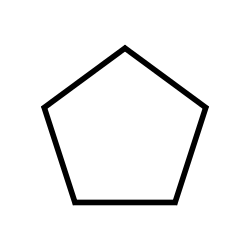\n\nThis molecule looks kinda like the one presented on the image that @artgor has generated. However, as we may see from the structural formula, there are no connections inside the molecule, all the carbon atoms are simply chained and connected only to two neighboring atoms.\n\nHowever, there is a certain type of organic molecules which are known to share a chemical connection amongst ALL of the atoms constituting a ring. And such type of compounds is called **aromatic compounds**. This is like a special concept in organic chemistry. I may go deeper in explaining it, if it is needed.\n\nSo, as far as I know there is only one aromatic five-member cyclic compound, and this is a cyclopentadienyl anion. It looks like this: \n\n\nI am new to this competition and have not studied the data myself yet. So, I do not yet know if this type of compounds is present in the datasets at all. However, if it does, then this image may be representing exactly this – an aromatic five-membered ring compound, where there is an aromatic connection between ALL of the five atoms constituting a ring.\n\nOr this may be just a funny artefact 😄", "votes": null }, { "id": "559922", "postDate": "06/24/2019 19:27:04", "content": "Nevermind my previous comment 😆 I have downloaded this molecule's xyz file and fed it into a chemical 3D drawing software. It seems that @alexeymorgunov is right – this is indeed methane. Because here is the image I have had generated by the program:\n
This is 100% methane here. Also, after looking at the .xyz file for this molecule, it is pretty obvious that this is indeed methane, as it is said to contain only 1 carbon atom and 4 hydrogen atoms. By any means there is only one molecule that has such a composition :)
\n\nNevertheless, I will still leave my previous comment. Maybe someone may find it useful. I'm still not quite sure that the datasets do not contain complex aromatic anions. Will have to dig deeper.
", "rawMarkdown": "Nevermind my previous comment 😆 I have downloaded this molecule's xyz file and fed it into a chemical 3D drawing software. It seems that @alexeymorgunov is right – this is indeed methane. Because here is the image I have had generated by the program:\n\n\nThis is 100% methane here. Also, after looking at the .xyz file for this molecule, it is pretty obvious that this is indeed methane, as it is said to contain only 1 carbon atom and 4 hydrogen atoms. By any means there is only one molecule that has such a composition :)\n\nNevertheless, I will still leave my previous comment. Maybe someone may find it useful. I'm still not quite sure that the datasets do not contain complex aromatic anions. Will have to dig deeper.", "votes": null } ], "comments": [ { "id": 557721, "author_name": "adrianoavelar", "author_url": "", "post_date": "06/21/2019 12:27:26", "content": "Hi Andrew. Could you explain the graph?
", "votes": null, "replies": [ { "id": 557770, "author_name": "artgor", "author_url": "", "post_date": "06/21/2019 13:02:47", "content": "The graph takes atom indices as nodes and tries to build a reasonable representation using dist as value to draw the edges.
That's methane. You have five atoms (one carbon, four hydrogens) all coupled to each other in a pairwise manner. What other graph can there be?:)
", "votes": null, "replies": [ { "id": 557771, "author_name": "artgor", "author_url": "", "post_date": "06/21/2019 13:03:02", "content": "Yeah! But I really liked how it looks like :)
", "votes": null, "replies": [] } ] }, { "id": 557794, "author_name": "stanislavblinov", "author_url": "", "post_date": "06/21/2019 13:21:55", "content": "Sorry, couldn't help it\n
Looks great but it does not look like CH4. The representation should have C as the central atom with Hs around it.
", "votes": null, "replies": [] }, { "id": 558723, "author_name": "andreacazzaniga86", "author_url": "", "post_date": "06/22/2019 19:59:50", "content": "In this representation all atoms seem to be evenly interchangeable, which is not what we want, right?
", "votes": null, "replies": [] }, { "id": 559918, "author_name": "mancy7", "author_url": "", "post_date": "06/24/2019 19:12:41", "content": "This type of atoms connection is very uncharacteristic of cyclic organic compounds. I mean, take a look at cyclopentane here:
This molecule looks kinda like the one presented on the image that @artgor has generated. However, as we may see from the structural formula, there are no connections inside the molecule, all the carbon atoms are simply chained and connected only to two neighboring atoms.
\n\nHowever, there is a certain type of organic molecules which are known to share a chemical connection amongst ALL of the atoms constituting a ring. And such type of compounds is called aromatic compounds. This is like a special concept in organic chemistry. I may go deeper in explaining it, if it is needed.
\n\nSo, as far as I know there is only one aromatic five-member cyclic compound, and this is a cyclopentadienyl anion. It looks like this: \n
I am new to this competition and have not studied the data myself yet. So, I do not yet know if this type of compounds is present in the datasets at all. However, if it does, then this image may be representing exactly this – an aromatic five-membered ring compound, where there is an aromatic connection between ALL of the five atoms constituting a ring.
\n\nOr this may be just a funny artefact 😄
", "votes": null, "replies": [] }, { "id": 559922, "author_name": "mancy7", "author_url": "", "post_date": "06/24/2019 19:27:04", "content": "Nevermind my previous comment 😆 I have downloaded this molecule's xyz file and fed it into a chemical 3D drawing software. It seems that @alexeymorgunov is right – this is indeed methane. Because here is the image I have had generated by the program:\n
This is 100% methane here. Also, after looking at the .xyz file for this molecule, it is pretty obvious that this is indeed methane, as it is said to contain only 1 carbon atom and 4 hydrogen atoms. By any means there is only one molecule that has such a composition :)
\n\nNevertheless, I will still leave my previous comment. Maybe someone may find it useful. I'm still not quite sure that the datasets do not contain complex aromatic anions. Will have to dig deeper.
", "votes": null, "replies": [] } ], "raw_markdown_by_id": { "557632": "I was playing with graphs and got this interesting result :)\n", "557721": "Hi Andrew. Could you explain the graph?", "557744": "That's methane. You have five atoms (one carbon, four hydrogens) all coupled to each other in a pairwise manner. What other graph can there be?:)", "557770": "The graph takes atom indices as nodes and tries to build a reasonable representation using `dist` as value to draw the edges.", "557771": "Yeah! But I really liked how it looks like :)", "557794": "Sorry, couldn't help it\n", "557994": "Looks great but it does not look like CH4. The representation should have C as the central atom with Hs around it.", "558723": "In this representation all atoms seem to be evenly interchangeable, which is not what we want, right?", "559918": "This type of atoms connection is very uncharacteristic of cyclic organic compounds. I mean, take a look at cyclopentane here: \n\nThis molecule looks kinda like the one presented on the image that @artgor has generated. However, as we may see from the structural formula, there are no connections inside the molecule, all the carbon atoms are simply chained and connected only to two neighboring atoms.\n\nHowever, there is a certain type of organic molecules which are known to share a chemical connection amongst ALL of the atoms constituting a ring. And such type of compounds is called **aromatic compounds**. This is like a special concept in organic chemistry. I may go deeper in explaining it, if it is needed.\n\nSo, as far as I know there is only one aromatic five-member cyclic compound, and this is a cyclopentadienyl anion. It looks like this: \n\n\nI am new to this competition and have not studied the data myself yet. So, I do not yet know if this type of compounds is present in the datasets at all. However, if it does, then this image may be representing exactly this – an aromatic five-membered ring compound, where there is an aromatic connection between ALL of the five atoms constituting a ring.\n\nOr this may be just a funny artefact 😄", "559922": "Nevermind my previous comment 😆 I have downloaded this molecule's xyz file and fed it into a chemical 3D drawing software. It seems that @alexeymorgunov is right – this is indeed methane. Because here is the image I have had generated by the program:\n\n\nThis is 100% methane here. Also, after looking at the .xyz file for this molecule, it is pretty obvious that this is indeed methane, as it is said to contain only 1 carbon atom and 4 hydrogen atoms. By any means there is only one molecule that has such a composition :)\n\nNevertheless, I will still leave my previous comment. Maybe someone may find it useful. I'm still not quite sure that the datasets do not contain complex aromatic anions. Will have to dig deeper." }, "source": "meta" }