{
"id": 97079,
"title": "Primer on Coupling and relation to Pascals Triangle",
"url": "/competitions/champs-scalar-coupling/discussion/97079",
"author_name": "cyberia",
"post_date": "2019-06-25T16:19:10.871000",
"votes": 12,
"comment_count": 0,
"views": 0,
"content": "I am analyzing the peaks in feature scalar_coupling_constant while learning more about the target feature. I found some interesting background info as follows for example take the molecule CH3CH2OH\n1H NMR spectrum (1-dimensional) of ethanol plotted as signal intensity vs. chemical shift. There are three different types of H atoms in ethanol regarding NMR. The hydrogen (H) on the -OH group is not coupling with the other H atoms and appears as a singlet, but the CH3- and the -CH2- hydrogens are coupling with each other, resulting in a triplet and quartet respectively.\n
\n\nThe relative intensitites of the lines in a coupling pattern is given by a binomial expansion or more conviently by Pascal's triangle.
\nTo derive Pascal's triangle, start at the apex, and generate each lower row by creating each number by adding the two numbers above and to either side in the row above together. The first six rows are shown to the right.
\nSo for H-NMR a proton with zero neighbours, n = 0, appears as a single line, a proton with one neighbours, n =1 as two lines of equal intensity, a proton with two neighbours, n = 2, as three lines of intensities 1 : 2 : 1, etc.\n
\n\nResult: \n- There are four peaks for H-(in green) because total number of H on C next to it in molecular formula = 3(H in blue) now from Pascals triangle look at row n = 3. You will see there are 4 terms namely 1, 3, 3, 1 This is corresponding to the peaks in the first image.
\n\n\n- There are three peaks for H-(in blue) because
total number of H on C next to it in molecular formula = 2(H in green) now from Pascals triangle look at row n = 2. You will see there are 3 terms namely 1, 2, 1 This is corresponding to the peaks in the first image. \n
\n\nQuestion : Enough of background info, tell me straight away what is this coupling constant?\nAnswer : \n \nIt's the difference among these peaks/lines.
\n\nI hope it helps.
\n\nResources:\nhttp://www.chem.ucalgary.ca/courses/350/Carey5th/Ch13/ch13-nmr-5.html\nhttps://en.wikipedia.org/wiki/Nuclear_magnetic_resonance_spectroscopy
",
"messages": [
{
"id": 560625,
"postDate": "2019-06-25T16:19:10.873Z",
"content": "I am analyzing the peaks in feature scalar_coupling_constant while learning more about the target feature. I found some interesting background info as follows for example take the molecule CH3CH2OH\n1H NMR spectrum (1-dimensional) of ethanol plotted as signal intensity vs. chemical shift. There are three different types of H atoms in ethanol regarding NMR. The hydrogen (H) on the -OH group is not coupling with the other H atoms and appears as a singlet, but the CH3- and the -CH2- hydrogens are coupling with each other, resulting in a triplet and quartet respectively.\n
\n\nThe relative intensitites of the lines in a coupling pattern is given by a binomial expansion or more conviently by Pascal's triangle.
\nTo derive Pascal's triangle, start at the apex, and generate each lower row by creating each number by adding the two numbers above and to either side in the row above together. The first six rows are shown to the right.
\nSo for H-NMR a proton with zero neighbours, n = 0, appears as a single line, a proton with one neighbours, n =1 as two lines of equal intensity, a proton with two neighbours, n = 2, as three lines of intensities 1 : 2 : 1, etc.\n
\n\nResult: \n- There are four peaks for H-(in green) because total number of H on C next to it in molecular formula = 3(H in blue) now from Pascals triangle look at row n = 3. You will see there are 4 terms namely 1, 3, 3, 1 This is corresponding to the peaks in the first image.
\n\n\n- There are three peaks for H-(in blue) because
total number of H on C next to it in molecular formula = 2(H in green) now from Pascals triangle look at row n = 2. You will see there are 3 terms namely 1, 2, 1 This is corresponding to the peaks in the first image. \n
\n\nQuestion : Enough of background info, tell me straight away what is this coupling constant?\nAnswer : \n\nIt's the difference among these peaks/lines.
\n\nI hope it helps.
\n\nResources:\nhttp://www.chem.ucalgary.ca/courses/350/Carey5th/Ch13/ch13-nmr-5.html\nhttps://en.wikipedia.org/wiki/Nuclear_magnetic_resonance_spectroscopy
",
"rawMarkdown": "I am analyzing the peaks in feature `scalar_coupling_constant` while learning more about the target feature. I found some interesting background info as follows for example take the molecule `CH3CH2OH`\n1H NMR spectrum (1-dimensional) of ethanol plotted as signal intensity vs. chemical shift. There are three different types of H atoms in ethanol regarding NMR. The hydrogen (H) on the -OH group is not coupling with the other H atoms and appears as a singlet, but the CH3- and the -CH2- hydrogens are coupling with each other, resulting in a triplet and quartet respectively.\n\n\nThe relative intensitites of the lines in a coupling pattern is given by a binomial expansion or more conviently by Pascal's triangle. \nTo derive Pascal's triangle, start at the apex, and generate each lower row by creating each number by adding the two numbers above and to either side in the row above together. The first six rows are shown to the right. \nSo for H-NMR a proton with zero neighbours, n = 0, appears as a single line, a proton with one neighbours, n =1 as two lines of equal intensity, a proton with two neighbours, n = 2, as three lines of intensities 1 : 2 : 1, etc.\n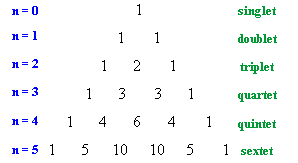\n\n**Result:** \n- There are four peaks for H-(in green) because `total number of H on C next to it in molecular formula = 3(H in blue)` now from Pascals triangle look at row `n = 3`. You will see there are 4 terms namely `1, 3, 3, 1` This is corresponding to the peaks in the first image.\n\n- There are three peaks for H-(in blue) because `total number of H on C next to it in molecular formula = 2(H in green)` now from Pascals triangle look at row `n = 2`. You will see there are 3 terms namely `1, 2, 1` This is corresponding to the peaks in the first image.\n\n\nQuestion : Enough of background info, tell me straight away what is this coupling constant?\nAnswer : \n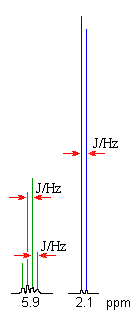\nIt's the difference among these peaks/lines.\n\nI hope it helps.\n\nResources:\nhttp://www.chem.ucalgary.ca/courses/350/Carey5th/Ch13/ch13-nmr-5.html\nhttps://en.wikipedia.org/wiki/Nuclear_magnetic_resonance_spectroscopy",
"votes": 12
}
],
"comments": [],
"raw_markdown_by_id": {
"560625": "I am analyzing the peaks in feature `scalar_coupling_constant` while learning more about the target feature. I found some interesting background info as follows for example take the molecule `CH3CH2OH`\n1H NMR spectrum (1-dimensional) of ethanol plotted as signal intensity vs. chemical shift. There are three different types of H atoms in ethanol regarding NMR. The hydrogen (H) on the -OH group is not coupling with the other H atoms and appears as a singlet, but the CH3- and the -CH2- hydrogens are coupling with each other, resulting in a triplet and quartet respectively.\n\n\nThe relative intensitites of the lines in a coupling pattern is given by a binomial expansion or more conviently by Pascal's triangle. \nTo derive Pascal's triangle, start at the apex, and generate each lower row by creating each number by adding the two numbers above and to either side in the row above together. The first six rows are shown to the right. \nSo for H-NMR a proton with zero neighbours, n = 0, appears as a single line, a proton with one neighbours, n =1 as two lines of equal intensity, a proton with two neighbours, n = 2, as three lines of intensities 1 : 2 : 1, etc.\n\n\n**Result:** \n- There are four peaks for H-(in green) because `total number of H on C next to it in molecular formula = 3(H in blue)` now from Pascals triangle look at row `n = 3`. You will see there are 4 terms namely `1, 3, 3, 1` This is corresponding to the peaks in the first image.\n\n- There are three peaks for H-(in blue) because `total number of H on C next to it in molecular formula = 2(H in green)` now from Pascals triangle look at row `n = 2`. You will see there are 3 terms namely `1, 2, 1` This is corresponding to the peaks in the first image.\n\n\nQuestion : Enough of background info, tell me straight away what is this coupling constant?\nAnswer : \n\nIt's the difference among these peaks/lines.\n\nI hope it helps.\n\nResources:\nhttp://www.chem.ucalgary.ca/courses/350/Carey5th/Ch13/ch13-nmr-5.html\nhttps://en.wikipedia.org/wiki/Nuclear_magnetic_resonance_spectroscopy"
}
}