{
  "id": 332426,
  "title": "[Digit Recognizer] Summary of all the top discussions posts ",
  "url": "/competitions/digit-recognizer/discussion/332426",
  "author_name": "The Devastator",
  "post_date": "2022-06-21T15:52:22.688000",
  "votes": 11,
  "comment_count": 3,
  "views": null,
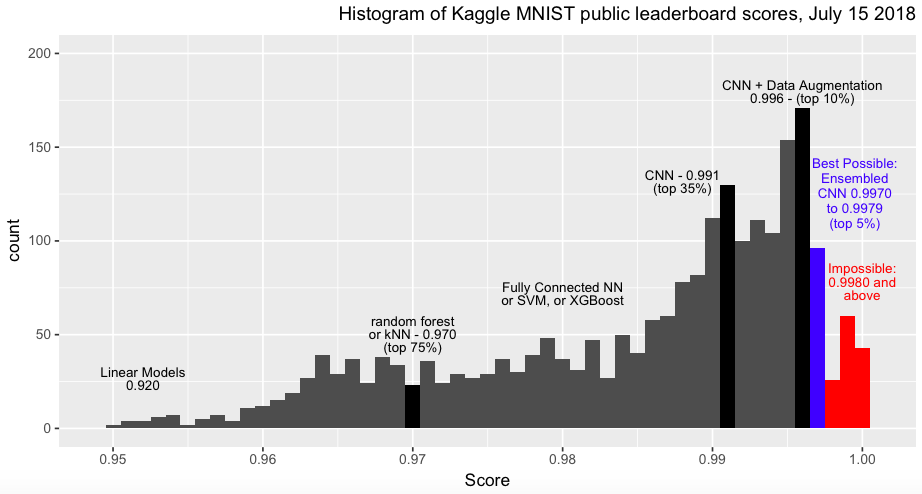
  "content": "<h3>[Digit Recognizer] Summary of all the top discussions posts</h3>\n<p><a href=\"https://www.kaggle.com/competitions/digit-recognizer/discussion/183700\" target=\"_blank\">Are 100% accuracies fake?</a> <br>\nby <a href=\"alifrahman\" target=\"_blank\">alifrahman</a></p>\n<ul>\n<li>A discussion about solutions with 100% acc: They are using the external public MNIST</li>\n<li><a href=\"https://www.kaggle.com/bgmello/how-top-lb-got-their-score-use-mnist-to-learn\" target=\"_blank\">Here</a> is a notebook that shows how to do this</li>\n</ul>\n<p><a href=\"https://www.kaggle.com/competitions/digit-recognizer/discussion/60305\" target=\"_blank\">kNN vs. Neural Network</a> <br>\nby <a href=\"cdeotte\" target=\"_blank\">cdeotte</a></p>\n<ul>\n<li>A discussion on why a neural network outperforms kNN.</li>\n<li>From the post: \"The problem is that kNN can not learn that pixel #5 is very important and pixel #13 is misleading. A neural network would learn this quickly and classify 100% of the digits correctly.\"</li>\n</ul>\n<p><a href=\"https://www.kaggle.com/competitions/digit-recognizer/discussion/26378\" target=\"_blank\">simple keras with lb 0.99071</a><br>\nby <a href=\"china1000\" target=\"_blank\">china1000</a></p>\n<ul>\n<li>Sharing an extremely simple keras model (on the discussion message, not a notebook), here it is minimized a bit:</li>\n</ul>\n<pre><code>import numpy as np\nimport pandas as pd\nfrom keras import backend as K\nfrom keras.models import Sequential\nfrom keras.layers.convolutional import *\nfrom keras.callbacks import EarlyStopping\nfrom keras.utils.np_utils import to_categorical\nfrom keras.layers.core import Dropout, Dense, Flatten, Activation\n\nK.set_image_dim_ordering('th')\n\ntrain_df, valid_df = pd.read_csv(\"../input/train.csv\"), pd.read_csv(\"../input/test.csv\")\n\nx_train = train_df.drop(['label'], axis=1).values.astype('float32')\nY_train = train_df['label'].values.astype('float32')\nx_valid = valid_df.values.astype('float32')\n\nn_train, n_valid = x_train.shape[0], x_valid.shape[0]\n\nx_train, x_valid = x_train.reshape(n_train,1, 28, 28), x_valid.reshape(n_valid, 1, 28, 28)\nx_train, x_valid = (x_train / 255), (x_valid/255)\n\nmodel = Sequential()\nmodel.add(Convolution2D(64, 3, 3, batch_input_shape=(None, 1, 28, 28), activation='relu', border_mode='valid'))\nmodel.add(MaxPooling2D(pool_size=(3, 3)))\nmodel.add(Convolution2D(64, 2, 2, activation='relu', border_mode='valid'))\nmodel.add(MaxPooling2D(pool_size=(1, 1)))\nmodel.add(Dropout(0.25))\nmodel.add(Flatten())\nmodel.add(Dense(128))\nmodel.add(Activation('relu'))\nmodel.add(Dropout(0.5))\nmodel.add(Dense(10))\nmodel.add(Activation('softmax'))\nmodel.compile(optimizer='adam', loss='categorical_crossentropy', metrics=['accuracy'])\n\nearly_stopping = EarlyStopping(monitor='val_acc', patience=1)\nmodel.fit(x_train, to_categorical(Y_train), batch_size = 128, nb_epoch=100, verbose = 2, validation_split = .2)\nyPred = model.predict_classes(x_valid,batch_size=32,verbose=1)\nnp.savetxt('mnist_output.csv', np.c_[range(1,len(yPred)+1),yPred], delimiter=',', header = 'ImageId,Label', comments = '', fmt='%d')\n</code></pre>\n<ul>\n<li>Sharing a <a href=\"https://www.kaggle.com/danielelton/digit-recognizer/keras-cnn-with-explanation/notebook\" target=\"_blank\">public notebook</a> with a simple keras model that got a public LB score of 0.99071.</li>\n</ul>\n<p><a href=\"https://www.kaggle.com/competitions/digit-recognizer/discussion/7221\" target=\"_blank\">98.83% with Weka, new NN package</a> <br>\nby <a href=\"johannesamten\" target=\"_blank\">johannesamten</a></p>\n<ul>\n<li>The package was used to get 98.83% accuracy.</li>\n<li>Sharing a <a href=\"https://github.com/amten/NeuralNetwork\" target=\"_blank\">Weka package</a> for a neural network with dropout and rectified linear units in java. [wow this is an old post..]</li>\n</ul>\n<p><a href=\"https://www.kaggle.com/competitions/digit-recognizer/discussion/62976\" target=\"_blank\">The way to get 99.571% accuracy with simple model using keras</a><br>\nby <a href=\"yugkhanna\" target=\"_blank\">yugkhanna</a></p>\n<ul>\n<li>Sharing a <a href=\"https://medium.com/@yugkhanna1/building-a-5-layer-cnn-model-with-keras-to-identify-handwritten-digits-complex-yet-simple-f06b8b375346\" target=\"_blank\">medium article</a> about how to get 99.571% accuracy with a simple model using keras.</li>\n</ul>\n<p><a href=\"https://www.kaggle.com/competitions/digit-recognizer/discussion/252787\" target=\"_blank\">Applications of Digit recognizer: Resume tricks</a> <br>\nby <a href=\"kritidoneria\" target=\"_blank\">kritidoneria</a></p>\n<ul>\n<li>The post suggest that the same infoprmation can expressed in different words and sound much more impressive as a CV line. From the post:</li>\n</ul>\n<pre><code>**Writing 'Digit recognizer' and 'MNIST' in your resume is cliché. Instead, try these:**\n- Bank cheque/invoices/documents processing using OCR (quantify the impact in terms of man hours having)\n- Document verification system ( OCR and ID verification)\n- Examination grading by digitization MCQ only)\n- Scientific notes digitizer\n- License-plate reading\n</code></pre>\n<p><a href=\"https://www.kaggle.com/competitions/digit-recognizer/discussion/4281\" target=\"_blank\">Sharing Python Code for KNN, SVC and Random Forest</a><br>\nby <a href=\"broham\" target=\"_blank\">broham</a></p>\n<ul>\n<li>Sharing a <a href=\"https://github.com/Broham/DigitRecognizer\" target=\"_blank\">GitHub repo</a> with Python code for KNN, SVC and Random Forest.</li>\n</ul>\n<p><a href=\"https://www.kaggle.com/competitions/digit-recognizer/discussion/2983\" target=\"_blank\">Downloading train.csv and test.csv</a> <br>\nby <a href=\"swethasharma\" target=\"_blank\">swethasharma</a></p>\n<ul>\n<li>The post discusses a downloading problem that happened before, on the comments it is suggested that the files had been reuploaded <a href=\"https://storage.googleapis.com/kaggle-forum-message-attachments/263398/8134/kaggle-digit-recognizer-data.tar.gz\" target=\"_blank\">here</a> as well if there is any problem in the future.</li>\n</ul>\n<p><a href=\"https://www.kaggle.com/competitions/digit-recognizer/discussion/43349\" target=\"_blank\">Simple tensorflow CNN - +99%</a><br>\nby <a href=\"julienknafou\" target=\"_blank\">julienknafou</a></p>\n<ul>\n<li>Sharing a top 1% solution both in the post itself and on <a href=\"https://github.com/KubaMichalczyk/kaggle-predict-future-sales\" target=\"_blank\">GitHub</a></li>\n</ul>\n<p><a href=\"https://www.kaggle.com/competitions/digit-recognizer/discussion/2299\" target=\"_blank\">Getting Started - Python Sample Code (Random Forest)</a> <br>\nby <a href=\"cclark\" target=\"_blank\">cclark</a></p>\n<ul>\n<li>Sharing a simple solution to generate the Random Forest benchmark</li>\n</ul>\n<pre><code>from numpy import genfromtxt, savetxt\nfrom sklearn.ensemble import RandomForestClassifier\n\ndef main():\n    #create the training &amp; test sets, skipping the header row with [1:]\n    dataset = genfromtxt(open('Data/train.csv','r'), delimiter=',', dtype='f8')[1:]\n    target = [x[0] for x in dataset]\n    train = [x[1:] for x in dataset]\n    test = genfromtxt(open('Data/test.csv','r'), delimiter=',', dtype='f8')[1:]\n    rf = RandomForestClassifier(n_estimators=100)\n    rf.fit(train, target)\n    savetxt('Data/submission2.csv', rf.predict(test), delimiter=',', fmt='%f')\n</code></pre>\n<p><a href=\"https://www.kaggle.com/competitions/digit-recognizer/discussion/163676\" target=\"_blank\">What is a good score?</a><br>\nby <a href=\"sanjaykrishnamurthi\" target=\"_blank\">sanjaykrishnamurthi</a></p>\n<ul>\n<li>Asking what a good score is in the Digit Recognizer competition.</li>\n<li>From the comments:</li>\n<li>'I think if you can cross 99.8% accuracy, it should be good enough. But, with further tweaks like using callback function, augmenting data and using deeper models, you can easily get the accuracy over 99.9%.'</li>\n<li>see <a href=\"https://www.kaggle.com/c/digit-recognizer/discussion/61480\" target=\"_blank\">this</a> post</li>\n</ul>\n<p><a href=\"https://www.kaggle.com/competitions/digit-recognizer/discussion/296110\" target=\"_blank\">You might be cheating without knowing it</a> <br>\nby <a href=\"samuelcortinhas\" target=\"_blank\">samuelcortinhas</a></p>\n<ul>\n<li>From the post: '''<br>\nin the top scoring notebooks:</li>\n</ul>\n<p>(X_train_mnist, y_train_mnist), (X_val_mnist, y_val_mnist) = mnist.load_data()</p>\n<p>kaggle uses a training/test split of 42k/28k whereas this dataset downloaded from keras has a 60k/10k split. This means you will be using some of kaggles test data to train your algorithm, which artificially improves your score because your algorithm is just memorising a lot of the right answers.<br>\n'''</p>\n<p><a href=\"https://www.kaggle.com/competitions/digit-recognizer/discussion/61480\" target=\"_blank\">How to score 97%, 98%, 99%, and 100%</a> <br>\nby <a href=\"cdeotte\" target=\"_blank\">cdeotte</a></p>\n<ul>\n<li>Sharing a histogram of Kaggle leaderboard scores where each bar has range 0.1%.<br>\n<img src=\"https://www.googleapis.com/download/storage/v1/b/kaggle-forum-message-attachments/o/inbox%2F1723677%2Fb858f6500a16f9a0e3e23ee9126b0069%2Fimg1.png?generation=1602506040379499&amp;alt=media\" alt=\"\"></li>\n<li>Sharing a schematic of a CNN architecture.</li>\n<li>A discussion on how to score 97%, 98%, <a href=\"https://www.kaggle.com/cdeotte/25-million-images-0-99757-mnist\" target=\"_blank\">99%</a>, and 100% on the MNIST dataset. (by simply trying many many many options)</li>\n<li>Sharing a <a href=\"https://www.kaggle.com/cdeotte/mnist-perfect-100-using-knn\" target=\"_blank\">link</a> to a notebook that scores 100%.</li>\n</ul>\n<p><a href=\"https://www.kaggle.com/competitions/digit-recognizer/discussion/161796\" target=\"_blank\">Important Research Papers worth Mentioning</a> <br>\nby <a href=\"ishandutta\" target=\"_blank\">ishandutta</a></p>\n<ul>\n<li>Sharing a list of research papers about handwritten digit recognition.</li>\n<li><a href=\"https://www.sciencedirect.com/science/article/abs/pii/S0262885604000721\" target=\"_blank\">Improved method of handwritten digit recognition tested on MNIST database</a></li>\n<li><a href=\"https://www.microsoft.com/en-us/research/wp-content/uploads/2016/02/MNIST-SPM2012.pdf\" target=\"_blank\">The MNIST Database of Handwritten Digit Images for Machine Learning Research</a></li>\n<li>]Deep Big Simple Neural Nets Excel on Handwritten Digit Recognition](<a href=\"https://arxiv.org/pdf/1003.0358.pdf\" target=\"_blank\">https://arxiv.org/pdf/1003.0358.pdf</a>)</li>\n<li><a href=\"https://www.sciencedirect.com/science/article/abs/pii/S0031320311004006\" target=\"_blank\">A novel hybrid CNN–SVM classifier for recognizing handwritten digits</a></li>\n<li><a href=\"http://people.idsia.ch/~juergen/NNtricks.pdf\" target=\"_blank\">Deep Big Multilayer Perceptrons For Digit Recognition</a></li>\n<li><a href=\"http://www.iapr-tc11.org/archive/icdar2011/fileup/PDF/4520b250.pdf\" target=\"_blank\">Better digit recognition with a committee of simple Neural Nets</a></li>\n<li><a href=\"https://hal.archives-ouvertes.fr/hal-02131170/document\" target=\"_blank\">Echo State Networks-based Reservoir Computing for MNIST Handwritten Digits Recognition</a></li>\n<li><a href=\"https://www.researchgate.net/profile/Badre_Eddine_El_Kessab2/publication/324845327_Extraction_Method_of_Handwritten_Digit_Recognition_Tested_on_the_MNIST_Database/links/5ae7914ea6fdcc03cd8db36d/Extraction-Method-of-Handwritten-Digit-Recognition-Tested-on-the-MNIST-Database.pdf\" target=\"_blank\">Extraction Method of Handwritten Digit Recognition Tested on the MNIST Database</a></li>\n<li><a href=\"https://ieeexplore.ieee.org/abstract/document/6755106\" target=\"_blank\">Handwritten Digit Recognition Using K-Nearest Neighbour Classifier</a></li>\n</ul>\n<p><a href=\"https://www.kaggle.com/competitions/digit-recognizer/discussion/93002\" target=\"_blank\">A beginner guide to MNIST - 0.9925%</a> <br>\nby <a href=\"shaygu\" target=\"_blank\">shaygu</a></p>\n<ul>\n<li>Sharing a <a href=\"https://www.kaggle.com/shaygu/fast-cnn-for-beginners-0-9923\" target=\"_blank\">public notebook</a> about a beginner guide to MNIST.</li>\n</ul>\n<p><a href=\"https://www.kaggle.com/competitions/digit-recognizer/discussion/80243\" target=\"_blank\">Reading in Data Directly to fast.ai</a> <br>\nby <a href=\"steventesta\" target=\"_blank\">steventesta</a></p>\n<ul>\n<li>Wrote a simple script for using fast.ai learner directly from the provided csv data.</li>\n</ul>\n<pre><code>class CustomImageItemList(ImageItemList):\n    def open(self, fn):\n        img = fn.reshape(28,28)\n        img = np.stack((img,)*3, axis=-1) # convert to 3 channels\n        return Image(pil2tensor(img, dtype=np.float32))\n\n    @classmethod\n    def from_csv_custom(cls, path:PathOrStr, csv_name:str, imgIdx:int=1, header:str='infer', **kwargs)-&gt;'ItemList':\n        df = pd.read_csv(Path(path)/csv_name, header=header)\n        res = super().from_df(df, path=path, cols=0, **kwargs)\n        # convert pixels to an ndarray\n        res.items = df.iloc[:,imgIdx:].apply(lambda x: x.values / 255.0, axis=1).values\n        return res\n</code></pre>\n<p>And usage would be as follows:</p>\n<pre><code>test = CustomImageItemList.from_csv_custom(path='./data', csv_name='test.csv', imgIdx=0)\ndata = (CustomImageItemList.from_csv_custom(path='./data', csv_name='train.csv')\n                       .random_split_by_pct(.2)\n                       .label_from_df(cols='label')\n                       .add_test(test, label=0)\n                       .databunch(bs=64, num_workers=0))\n</code></pre>\n<ul>\n<li>Sharing a <a href=\"https://www.kaggle.com/steventesta/digit-recognizer-fast-ai-custom-databunch\" target=\"_blank\">public notebook</a> about reading in data directly to fast.ai.</li>\n</ul>\n<p><a href=\"https://www.kaggle.com/competitions/digit-recognizer/discussion/116424\" target=\"_blank\">Interactive MNIST Digits Recognition visual Tableau</a><br>\nby <a href=\"zinovadr\" target=\"_blank\">zinovadr</a></p>\n<ul>\n<li>Sharing an <a href=\"https://public.tableau.com/profile/adrian.zinovei#!/vizhome/MNIST-DigitsAnalyzerKAGGLE/MNISTANALIZER\" target=\"_blank\">interactive MNIST Digits Recognition visual Tableau</a></li>\n</ul>\n<p><img src=\"https://www.googleapis.com/download/storage/v1/b/kaggle-user-content/o/inbox%2F2986379%2F3ccf4c6875ae59ff5a3073c67e075476%2FMNIST%20Digits.gif?generation=1573259567531991&amp;alt=media\" alt=\"\"></p>",
  "messages": [
    {
      "id": 1828301,
      "postDate": "2022-06-21T15:52:22.690Z",
      "content": "<h3>[Digit Recognizer] Summary of all the top discussions posts</h3>\n<p><a href=\"https://www.kaggle.com/competitions/digit-recognizer/discussion/183700\" target=\"_blank\">Are 100% accuracies fake?</a> <br>\nby <a href=\"alifrahman\" target=\"_blank\">alifrahman</a></p>\n<ul>\n<li>A discussion about solutions with 100% acc: They are using the external public MNIST</li>\n<li><a href=\"https://www.kaggle.com/bgmello/how-top-lb-got-their-score-use-mnist-to-learn\" target=\"_blank\">Here</a> is a notebook that shows how to do this</li>\n</ul>\n<p><a href=\"https://www.kaggle.com/competitions/digit-recognizer/discussion/60305\" target=\"_blank\">kNN vs. Neural Network</a> <br>\nby <a href=\"cdeotte\" target=\"_blank\">cdeotte</a></p>\n<ul>\n<li>A discussion on why a neural network outperforms kNN.</li>\n<li>From the post: \"The problem is that kNN can not learn that pixel #5 is very important and pixel #13 is misleading. A neural network would learn this quickly and classify 100% of the digits correctly.\"</li>\n</ul>\n<p><a href=\"https://www.kaggle.com/competitions/digit-recognizer/discussion/26378\" target=\"_blank\">simple keras with lb 0.99071</a><br>\nby <a href=\"china1000\" target=\"_blank\">china1000</a></p>\n<ul>\n<li>Sharing an extremely simple keras model (on the discussion message, not a notebook), here it is minimized a bit:</li>\n</ul>\n<pre><code>import numpy as np\nimport pandas as pd\nfrom keras import backend as K\nfrom keras.models import Sequential\nfrom keras.layers.convolutional import *\nfrom keras.callbacks import EarlyStopping\nfrom keras.utils.np_utils import to_categorical\nfrom keras.layers.core import Dropout, Dense, Flatten, Activation\n\nK.set_image_dim_ordering('th')\n\ntrain_df, valid_df = pd.read_csv(\"../input/train.csv\"), pd.read_csv(\"../input/test.csv\")\n\nx_train = train_df.drop(['label'], axis=1).values.astype('float32')\nY_train = train_df['label'].values.astype('float32')\nx_valid = valid_df.values.astype('float32')\n\nn_train, n_valid = x_train.shape[0], x_valid.shape[0]\n\nx_train, x_valid = x_train.reshape(n_train,1, 28, 28), x_valid.reshape(n_valid, 1, 28, 28)\nx_train, x_valid = (x_train / 255), (x_valid/255)\n\nmodel = Sequential()\nmodel.add(Convolution2D(64, 3, 3, batch_input_shape=(None, 1, 28, 28), activation='relu', border_mode='valid'))\nmodel.add(MaxPooling2D(pool_size=(3, 3)))\nmodel.add(Convolution2D(64, 2, 2, activation='relu', border_mode='valid'))\nmodel.add(MaxPooling2D(pool_size=(1, 1)))\nmodel.add(Dropout(0.25))\nmodel.add(Flatten())\nmodel.add(Dense(128))\nmodel.add(Activation('relu'))\nmodel.add(Dropout(0.5))\nmodel.add(Dense(10))\nmodel.add(Activation('softmax'))\nmodel.compile(optimizer='adam', loss='categorical_crossentropy', metrics=['accuracy'])\n\nearly_stopping = EarlyStopping(monitor='val_acc', patience=1)\nmodel.fit(x_train, to_categorical(Y_train), batch_size = 128, nb_epoch=100, verbose = 2, validation_split = .2)\nyPred = model.predict_classes(x_valid,batch_size=32,verbose=1)\nnp.savetxt('mnist_output.csv', np.c_[range(1,len(yPred)+1),yPred], delimiter=',', header = 'ImageId,Label', comments = '', fmt='%d')\n</code></pre>\n<ul>\n<li>Sharing a <a href=\"https://www.kaggle.com/danielelton/digit-recognizer/keras-cnn-with-explanation/notebook\" target=\"_blank\">public notebook</a> with a simple keras model that got a public LB score of 0.99071.</li>\n</ul>\n<p><a href=\"https://www.kaggle.com/competitions/digit-recognizer/discussion/7221\" target=\"_blank\">98.83% with Weka, new NN package</a> <br>\nby <a href=\"johannesamten\" target=\"_blank\">johannesamten</a></p>\n<ul>\n<li>The package was used to get 98.83% accuracy.</li>\n<li>Sharing a <a href=\"https://github.com/amten/NeuralNetwork\" target=\"_blank\">Weka package</a> for a neural network with dropout and rectified linear units in java. [wow this is an old post..]</li>\n</ul>\n<p><a href=\"https://www.kaggle.com/competitions/digit-recognizer/discussion/62976\" target=\"_blank\">The way to get 99.571% accuracy with simple model using keras</a><br>\nby <a href=\"yugkhanna\" target=\"_blank\">yugkhanna</a></p>\n<ul>\n<li>Sharing a <a href=\"https://medium.com/@yugkhanna1/building-a-5-layer-cnn-model-with-keras-to-identify-handwritten-digits-complex-yet-simple-f06b8b375346\" target=\"_blank\">medium article</a> about how to get 99.571% accuracy with a simple model using keras.</li>\n</ul>\n<p><a href=\"https://www.kaggle.com/competitions/digit-recognizer/discussion/252787\" target=\"_blank\">Applications of Digit recognizer: Resume tricks</a> <br>\nby <a href=\"kritidoneria\" target=\"_blank\">kritidoneria</a></p>\n<ul>\n<li>The post suggest that the same infoprmation can expressed in different words and sound much more impressive as a CV line. From the post:</li>\n</ul>\n<pre><code>**Writing 'Digit recognizer' and 'MNIST' in your resume is cliché. Instead, try these:**\n- Bank cheque/invoices/documents processing using OCR (quantify the impact in terms of man hours having)\n- Document verification system ( OCR and ID verification)\n- Examination grading by digitization MCQ only)\n- Scientific notes digitizer\n- License-plate reading\n</code></pre>\n<p><a href=\"https://www.kaggle.com/competitions/digit-recognizer/discussion/4281\" target=\"_blank\">Sharing Python Code for KNN, SVC and Random Forest</a><br>\nby <a href=\"broham\" target=\"_blank\">broham</a></p>\n<ul>\n<li>Sharing a <a href=\"https://github.com/Broham/DigitRecognizer\" target=\"_blank\">GitHub repo</a> with Python code for KNN, SVC and Random Forest.</li>\n</ul>\n<p><a href=\"https://www.kaggle.com/competitions/digit-recognizer/discussion/2983\" target=\"_blank\">Downloading train.csv and test.csv</a> <br>\nby <a href=\"swethasharma\" target=\"_blank\">swethasharma</a></p>\n<ul>\n<li>The post discusses a downloading problem that happened before, on the comments it is suggested that the files had been reuploaded <a href=\"https://storage.googleapis.com/kaggle-forum-message-attachments/263398/8134/kaggle-digit-recognizer-data.tar.gz\" target=\"_blank\">here</a> as well if there is any problem in the future.</li>\n</ul>\n<p><a href=\"https://www.kaggle.com/competitions/digit-recognizer/discussion/43349\" target=\"_blank\">Simple tensorflow CNN - +99%</a><br>\nby <a href=\"julienknafou\" target=\"_blank\">julienknafou</a></p>\n<ul>\n<li>Sharing a top 1% solution both in the post itself and on <a href=\"https://github.com/KubaMichalczyk/kaggle-predict-future-sales\" target=\"_blank\">GitHub</a></li>\n</ul>\n<p><a href=\"https://www.kaggle.com/competitions/digit-recognizer/discussion/2299\" target=\"_blank\">Getting Started - Python Sample Code (Random Forest)</a> <br>\nby <a href=\"cclark\" target=\"_blank\">cclark</a></p>\n<ul>\n<li>Sharing a simple solution to generate the Random Forest benchmark</li>\n</ul>\n<pre><code>from numpy import genfromtxt, savetxt\nfrom sklearn.ensemble import RandomForestClassifier\n\ndef main():\n    #create the training &amp; test sets, skipping the header row with [1:]\n    dataset = genfromtxt(open('Data/train.csv','r'), delimiter=',', dtype='f8')[1:]\n    target = [x[0] for x in dataset]\n    train = [x[1:] for x in dataset]\n    test = genfromtxt(open('Data/test.csv','r'), delimiter=',', dtype='f8')[1:]\n    rf = RandomForestClassifier(n_estimators=100)\n    rf.fit(train, target)\n    savetxt('Data/submission2.csv', rf.predict(test), delimiter=',', fmt='%f')\n</code></pre>\n<p><a href=\"https://www.kaggle.com/competitions/digit-recognizer/discussion/163676\" target=\"_blank\">What is a good score?</a><br>\nby <a href=\"sanjaykrishnamurthi\" target=\"_blank\">sanjaykrishnamurthi</a></p>\n<ul>\n<li>Asking what a good score is in the Digit Recognizer competition.</li>\n<li>From the comments:</li>\n<li>'I think if you can cross 99.8% accuracy, it should be good enough. But, with further tweaks like using callback function, augmenting data and using deeper models, you can easily get the accuracy over 99.9%.'</li>\n<li>see <a href=\"https://www.kaggle.com/c/digit-recognizer/discussion/61480\" target=\"_blank\">this</a> post</li>\n</ul>\n<p><a href=\"https://www.kaggle.com/competitions/digit-recognizer/discussion/296110\" target=\"_blank\">You might be cheating without knowing it</a> <br>\nby <a href=\"samuelcortinhas\" target=\"_blank\">samuelcortinhas</a></p>\n<ul>\n<li>From the post: '''<br>\nin the top scoring notebooks:</li>\n</ul>\n<p>(X_train_mnist, y_train_mnist), (X_val_mnist, y_val_mnist) = mnist.load_data()</p>\n<p>kaggle uses a training/test split of 42k/28k whereas this dataset downloaded from keras has a 60k/10k split. This means you will be using some of kaggles test data to train your algorithm, which artificially improves your score because your algorithm is just memorising a lot of the right answers.<br>\n'''</p>\n<p><a href=\"https://www.kaggle.com/competitions/digit-recognizer/discussion/61480\" target=\"_blank\">How to score 97%, 98%, 99%, and 100%</a> <br>\nby <a href=\"cdeotte\" target=\"_blank\">cdeotte</a></p>\n<ul>\n<li>Sharing a histogram of Kaggle leaderboard scores where each bar has range 0.1%.<br>\n<img src=\"https://www.googleapis.com/download/storage/v1/b/kaggle-forum-message-attachments/o/inbox%2F1723677%2Fb858f6500a16f9a0e3e23ee9126b0069%2Fimg1.png?generation=1602506040379499&amp;alt=media\" alt=\"\"></li>\n<li>Sharing a schematic of a CNN architecture.</li>\n<li>A discussion on how to score 97%, 98%, <a href=\"https://www.kaggle.com/cdeotte/25-million-images-0-99757-mnist\" target=\"_blank\">99%</a>, and 100% on the MNIST dataset. (by simply trying many many many options)</li>\n<li>Sharing a <a href=\"https://www.kaggle.com/cdeotte/mnist-perfect-100-using-knn\" target=\"_blank\">link</a> to a notebook that scores 100%.</li>\n</ul>\n<p><a href=\"https://www.kaggle.com/competitions/digit-recognizer/discussion/161796\" target=\"_blank\">Important Research Papers worth Mentioning</a> <br>\nby <a href=\"ishandutta\" target=\"_blank\">ishandutta</a></p>\n<ul>\n<li>Sharing a list of research papers about handwritten digit recognition.</li>\n<li><a href=\"https://www.sciencedirect.com/science/article/abs/pii/S0262885604000721\" target=\"_blank\">Improved method of handwritten digit recognition tested on MNIST database</a></li>\n<li><a href=\"https://www.microsoft.com/en-us/research/wp-content/uploads/2016/02/MNIST-SPM2012.pdf\" target=\"_blank\">The MNIST Database of Handwritten Digit Images for Machine Learning Research</a></li>\n<li>]Deep Big Simple Neural Nets Excel on Handwritten Digit Recognition](<a href=\"https://arxiv.org/pdf/1003.0358.pdf\" target=\"_blank\">https://arxiv.org/pdf/1003.0358.pdf</a>)</li>\n<li><a href=\"https://www.sciencedirect.com/science/article/abs/pii/S0031320311004006\" target=\"_blank\">A novel hybrid CNN–SVM classifier for recognizing handwritten digits</a></li>\n<li><a href=\"http://people.idsia.ch/~juergen/NNtricks.pdf\" target=\"_blank\">Deep Big Multilayer Perceptrons For Digit Recognition</a></li>\n<li><a href=\"http://www.iapr-tc11.org/archive/icdar2011/fileup/PDF/4520b250.pdf\" target=\"_blank\">Better digit recognition with a committee of simple Neural Nets</a></li>\n<li><a href=\"https://hal.archives-ouvertes.fr/hal-02131170/document\" target=\"_blank\">Echo State Networks-based Reservoir Computing for MNIST Handwritten Digits Recognition</a></li>\n<li><a href=\"https://www.researchgate.net/profile/Badre_Eddine_El_Kessab2/publication/324845327_Extraction_Method_of_Handwritten_Digit_Recognition_Tested_on_the_MNIST_Database/links/5ae7914ea6fdcc03cd8db36d/Extraction-Method-of-Handwritten-Digit-Recognition-Tested-on-the-MNIST-Database.pdf\" target=\"_blank\">Extraction Method of Handwritten Digit Recognition Tested on the MNIST Database</a></li>\n<li><a href=\"https://ieeexplore.ieee.org/abstract/document/6755106\" target=\"_blank\">Handwritten Digit Recognition Using K-Nearest Neighbour Classifier</a></li>\n</ul>\n<p><a href=\"https://www.kaggle.com/competitions/digit-recognizer/discussion/93002\" target=\"_blank\">A beginner guide to MNIST - 0.9925%</a> <br>\nby <a href=\"shaygu\" target=\"_blank\">shaygu</a></p>\n<ul>\n<li>Sharing a <a href=\"https://www.kaggle.com/shaygu/fast-cnn-for-beginners-0-9923\" target=\"_blank\">public notebook</a> about a beginner guide to MNIST.</li>\n</ul>\n<p><a href=\"https://www.kaggle.com/competitions/digit-recognizer/discussion/80243\" target=\"_blank\">Reading in Data Directly to fast.ai</a> <br>\nby <a href=\"steventesta\" target=\"_blank\">steventesta</a></p>\n<ul>\n<li>Wrote a simple script for using fast.ai learner directly from the provided csv data.</li>\n</ul>\n<pre><code>class CustomImageItemList(ImageItemList):\n    def open(self, fn):\n        img = fn.reshape(28,28)\n        img = np.stack((img,)*3, axis=-1) # convert to 3 channels\n        return Image(pil2tensor(img, dtype=np.float32))\n\n    @classmethod\n    def from_csv_custom(cls, path:PathOrStr, csv_name:str, imgIdx:int=1, header:str='infer', **kwargs)-&gt;'ItemList':\n        df = pd.read_csv(Path(path)/csv_name, header=header)\n        res = super().from_df(df, path=path, cols=0, **kwargs)\n        # convert pixels to an ndarray\n        res.items = df.iloc[:,imgIdx:].apply(lambda x: x.values / 255.0, axis=1).values\n        return res\n</code></pre>\n<p>And usage would be as follows:</p>\n<pre><code>test = CustomImageItemList.from_csv_custom(path='./data', csv_name='test.csv', imgIdx=0)\ndata = (CustomImageItemList.from_csv_custom(path='./data', csv_name='train.csv')\n                       .random_split_by_pct(.2)\n                       .label_from_df(cols='label')\n                       .add_test(test, label=0)\n                       .databunch(bs=64, num_workers=0))\n</code></pre>\n<ul>\n<li>Sharing a <a href=\"https://www.kaggle.com/steventesta/digit-recognizer-fast-ai-custom-databunch\" target=\"_blank\">public notebook</a> about reading in data directly to fast.ai.</li>\n</ul>\n<p><a href=\"https://www.kaggle.com/competitions/digit-recognizer/discussion/116424\" target=\"_blank\">Interactive MNIST Digits Recognition visual Tableau</a><br>\nby <a href=\"zinovadr\" target=\"_blank\">zinovadr</a></p>\n<ul>\n<li>Sharing an <a href=\"https://public.tableau.com/profile/adrian.zinovei#!/vizhome/MNIST-DigitsAnalyzerKAGGLE/MNISTANALIZER\" target=\"_blank\">interactive MNIST Digits Recognition visual Tableau</a></li>\n</ul>\n<p><img src=\"https://www.googleapis.com/download/storage/v1/b/kaggle-user-content/o/inbox%2F2986379%2F3ccf4c6875ae59ff5a3073c67e075476%2FMNIST%20Digits.gif?generation=1573259567531991&amp;alt=media\" alt=\"\"></p>",
      "rawMarkdown": "### [Digit Recognizer] Summary of all the top discussions posts \n\n\n[Are 100% accuracies fake?](https://www.kaggle.com/competitions/digit-recognizer/discussion/183700) \nby [alifrahman](alifrahman)\n\n- A discussion about solutions with 100% acc: They are using the external public MNIST\n- [Here](https://www.kaggle.com/bgmello/how-top-lb-got-their-score-use-mnist-to-learn) is a notebook that shows how to do this\n\n[kNN vs. Neural Network](https://www.kaggle.com/competitions/digit-recognizer/discussion/60305) \nby [cdeotte](cdeotte)\n\n- A discussion on why a neural network outperforms kNN.\n- From the post: \"The problem is that kNN can not learn that pixel #5 is very important and pixel #13 is misleading. A neural network would learn this quickly and classify 100% of the digits correctly.\"\n\n[simple keras with lb 0.99071](https://www.kaggle.com/competitions/digit-recognizer/discussion/26378)\nby [china1000](china1000)\n\n- Sharing an extremely simple keras model (on the discussion message, not a notebook), here it is minimized a bit:\n```python\n\nimport numpy as np\nimport pandas as pd\nfrom keras import backend as K\nfrom keras.models import Sequential\nfrom keras.layers.convolutional import *\nfrom keras.callbacks import EarlyStopping\nfrom keras.utils.np_utils import to_categorical\nfrom keras.layers.core import Dropout, Dense, Flatten, Activation\n\nK.set_image_dim_ordering('th')\n\ntrain_df, valid_df = pd.read_csv(\"../input/train.csv\"), pd.read_csv(\"../input/test.csv\")\n\nx_train = train_df.drop(['label'], axis=1).values.astype('float32')\nY_train = train_df['label'].values.astype('float32')\nx_valid = valid_df.values.astype('float32')\n\nn_train, n_valid = x_train.shape[0], x_valid.shape[0]\n\nx_train, x_valid = x_train.reshape(n_train,1, 28, 28), x_valid.reshape(n_valid, 1, 28, 28)\nx_train, x_valid = (x_train / 255), (x_valid/255)\n\nmodel = Sequential()\nmodel.add(Convolution2D(64, 3, 3, batch_input_shape=(None, 1, 28, 28), activation='relu', border_mode='valid'))\nmodel.add(MaxPooling2D(pool_size=(3, 3)))\nmodel.add(Convolution2D(64, 2, 2, activation='relu', border_mode='valid'))\nmodel.add(MaxPooling2D(pool_size=(1, 1)))\nmodel.add(Dropout(0.25))\nmodel.add(Flatten())\nmodel.add(Dense(128))\nmodel.add(Activation('relu'))\nmodel.add(Dropout(0.5))\nmodel.add(Dense(10))\nmodel.add(Activation('softmax'))\nmodel.compile(optimizer='adam', loss='categorical_crossentropy', metrics=['accuracy'])\n\nearly_stopping = EarlyStopping(monitor='val_acc', patience=1)\nmodel.fit(x_train, to_categorical(Y_train), batch_size = 128, nb_epoch=100, verbose = 2, validation_split = .2)\nyPred = model.predict_classes(x_valid,batch_size=32,verbose=1)\nnp.savetxt('mnist_output.csv', np.c_[range(1,len(yPred)+1),yPred], delimiter=',', header = 'ImageId,Label', comments = '', fmt='%d')\n```\n\n- Sharing a [public notebook](https://www.kaggle.com/danielelton/digit-recognizer/keras-cnn-with-explanation/notebook) with a simple keras model that got a public LB score of 0.99071.\n\n[98.83% with Weka, new NN package](https://www.kaggle.com/competitions/digit-recognizer/discussion/7221) \nby [johannesamten](johannesamten)\n\n- The package was used to get 98.83% accuracy.\n- Sharing a [Weka package](https://github.com/amten/NeuralNetwork) for a neural network with dropout and rectified linear units in java. [wow this is an old post..]\n\n[The way to get 99.571% accuracy with simple model using keras](https://www.kaggle.com/competitions/digit-recognizer/discussion/62976)\nby [yugkhanna](yugkhanna)\n\n- Sharing a [medium article](https://medium.com/@yugkhanna1/building-a-5-layer-cnn-model-with-keras-to-identify-handwritten-digits-complex-yet-simple-f06b8b375346) about how to get 99.571% accuracy with a simple model using keras.\n\n[Applications of Digit recognizer: Resume tricks](https://www.kaggle.com/competitions/digit-recognizer/discussion/252787) \nby [kritidoneria](kritidoneria)\n\n- The post suggest that the same infoprmation can expressed in different words and sound much more impressive as a CV line. From the post:\n\n```\n**Writing 'Digit recognizer' and 'MNIST' in your resume is cliché. Instead, try these:**\n- Bank cheque/invoices/documents processing using OCR (quantify the impact in terms of man hours having)\n- Document verification system ( OCR and ID verification)\n- Examination grading by digitization MCQ only)\n- Scientific notes digitizer\n- License-plate reading\n```\n\n[Sharing Python Code for KNN, SVC and Random Forest](https://www.kaggle.com/competitions/digit-recognizer/discussion/4281)\nby [broham](broham)\n\n- Sharing a [GitHub repo](https://github.com/Broham/DigitRecognizer) with Python code for KNN, SVC and Random Forest.\n\n[Downloading train.csv and test.csv](https://www.kaggle.com/competitions/digit-recognizer/discussion/2983) \nby [swethasharma](swethasharma)\n\n- The post discusses a downloading problem that happened before, on the comments it is suggested that the files had been reuploaded [here](https://storage.googleapis.com/kaggle-forum-message-attachments/263398/8134/kaggle-digit-recognizer-data.tar.gz) as well if there is any problem in the future.\n\n[Simple tensorflow CNN - +99%](https://www.kaggle.com/competitions/digit-recognizer/discussion/43349)\nby [julienknafou](julienknafou)\n\n- Sharing a top 1% solution both in the post itself and on [GitHub](https://github.com/KubaMichalczyk/kaggle-predict-future-sales)\n\n[Getting Started - Python Sample Code (Random Forest)](https://www.kaggle.com/competitions/digit-recognizer/discussion/2299) \nby [cclark](cclark)\n\n- Sharing a simple solution to generate the Random Forest benchmark\n```python\nfrom numpy import genfromtxt, savetxt\nfrom sklearn.ensemble import RandomForestClassifier\n\ndef main():\n    #create the training & test sets, skipping the header row with [1:]\n    dataset = genfromtxt(open('Data/train.csv','r'), delimiter=',', dtype='f8')[1:]\n    target = [x[0] for x in dataset]\n    train = [x[1:] for x in dataset]\n    test = genfromtxt(open('Data/test.csv','r'), delimiter=',', dtype='f8')[1:]\n    rf = RandomForestClassifier(n_estimators=100)\n    rf.fit(train, target)\n    savetxt('Data/submission2.csv', rf.predict(test), delimiter=',', fmt='%f')\n\n```\n\n[What is a good score?](https://www.kaggle.com/competitions/digit-recognizer/discussion/163676)\nby [sanjaykrishnamurthi](sanjaykrishnamurthi)\n\n- Asking what a good score is in the Digit Recognizer competition.\n- From the comments:\n- 'I think if you can cross 99.8% accuracy, it should be good enough. But, with further tweaks like using callback function, augmenting data and using deeper models, you can easily get the accuracy over 99.9%.'\n- see [this](https://www.kaggle.com/c/digit-recognizer/discussion/61480) post\n\n[You might be cheating without knowing it](https://www.kaggle.com/competitions/digit-recognizer/discussion/296110) \nby [samuelcortinhas](samuelcortinhas)\n\n- From the post: '''\nin the top scoring notebooks:\n\n(X_train_mnist, y_train_mnist), (X_val_mnist, y_val_mnist) = mnist.load_data()\n\nkaggle uses a training/test split of 42k/28k whereas this dataset downloaded from keras has a 60k/10k split. This means you will be using some of kaggles test data to train your algorithm, which artificially improves your score because your algorithm is just memorising a lot of the right answers.\n'''\n\n[How to score 97%, 98%, 99%, and 100%](https://www.kaggle.com/competitions/digit-recognizer/discussion/61480) \nby [cdeotte](cdeotte)\n\n- Sharing a histogram of Kaggle leaderboard scores where each bar has range 0.1%.\n![](https://www.googleapis.com/download/storage/v1/b/kaggle-forum-message-attachments/o/inbox%2F1723677%2Fb858f6500a16f9a0e3e23ee9126b0069%2Fimg1.png?generation=1602506040379499&alt=media)\n- Sharing a schematic of a CNN architecture.\n- A discussion on how to score 97%, 98%, [99%](https://www.kaggle.com/cdeotte/25-million-images-0-99757-mnist), and 100% on the MNIST dataset. (by simply trying many many many options)\n- Sharing a [link](https://www.kaggle.com/cdeotte/mnist-perfect-100-using-knn) to a notebook that scores 100%.\n\n[Important Research Papers worth Mentioning](https://www.kaggle.com/competitions/digit-recognizer/discussion/161796) \nby [ishandutta](ishandutta)\n\n- Sharing a list of research papers about handwritten digit recognition.\n- [Improved method of handwritten digit recognition tested on MNIST database](https://www.sciencedirect.com/science/article/abs/pii/S0262885604000721)\n- [The MNIST Database of Handwritten Digit Images for Machine Learning Research](https://www.microsoft.com/en-us/research/wp-content/uploads/2016/02/MNIST-SPM2012.pdf)\n- ]Deep Big Simple Neural Nets Excel on Handwritten Digit Recognition](https://arxiv.org/pdf/1003.0358.pdf)\n- [A novel hybrid CNN–SVM classifier for recognizing handwritten digits](https://www.sciencedirect.com/science/article/abs/pii/S0031320311004006)\n- [Deep Big Multilayer Perceptrons For Digit Recognition](http://people.idsia.ch/~juergen/NNtricks.pdf)\n- [Better digit recognition with a committee of simple Neural Nets](http://www.iapr-tc11.org/archive/icdar2011/fileup/PDF/4520b250.pdf)\n- [Echo State Networks-based Reservoir Computing for MNIST Handwritten Digits Recognition](https://hal.archives-ouvertes.fr/hal-02131170/document)\n- [Extraction Method of Handwritten Digit Recognition Tested on the MNIST Database](https://www.researchgate.net/profile/Badre_Eddine_El_Kessab2/publication/324845327_Extraction_Method_of_Handwritten_Digit_Recognition_Tested_on_the_MNIST_Database/links/5ae7914ea6fdcc03cd8db36d/Extraction-Method-of-Handwritten-Digit-Recognition-Tested-on-the-MNIST-Database.pdf)\n- [Handwritten Digit Recognition Using K-Nearest Neighbour Classifier](https://ieeexplore.ieee.org/abstract/document/6755106)\n\n[A beginner guide to MNIST - 0.9925%](https://www.kaggle.com/competitions/digit-recognizer/discussion/93002) \nby [shaygu](shaygu)\n\n- Sharing a [public notebook](https://www.kaggle.com/shaygu/fast-cnn-for-beginners-0-9923) about a beginner guide to MNIST.\n\n[Reading in Data Directly to fast.ai](https://www.kaggle.com/competitions/digit-recognizer/discussion/80243) \nby [steventesta](steventesta)\n\n- Wrote a simple script for using fast.ai learner directly from the provided csv data.\n```python\nclass CustomImageItemList(ImageItemList):\n    def open(self, fn):\n        img = fn.reshape(28,28)\n        img = np.stack((img,)*3, axis=-1) # convert to 3 channels\n        return Image(pil2tensor(img, dtype=np.float32))\n\n    @classmethod\n    def from_csv_custom(cls, path:PathOrStr, csv_name:str, imgIdx:int=1, header:str='infer', **kwargs)->'ItemList':\n        df = pd.read_csv(Path(path)/csv_name, header=header)\n        res = super().from_df(df, path=path, cols=0, **kwargs)\n        # convert pixels to an ndarray\n        res.items = df.iloc[:,imgIdx:].apply(lambda x: x.values / 255.0, axis=1).values\n        return res\n```\n\nAnd usage would be as follows:\n\n```python\ntest = CustomImageItemList.from_csv_custom(path='./data', csv_name='test.csv', imgIdx=0)\ndata = (CustomImageItemList.from_csv_custom(path='./data', csv_name='train.csv')\n                       .random_split_by_pct(.2)\n                       .label_from_df(cols='label')\n                       .add_test(test, label=0)\n                       .databunch(bs=64, num_workers=0))\n```\n\n- Sharing a [public notebook](https://www.kaggle.com/steventesta/digit-recognizer-fast-ai-custom-databunch) about reading in data directly to fast.ai.\n\n[Interactive MNIST Digits Recognition visual Tableau](https://www.kaggle.com/competitions/digit-recognizer/discussion/116424)\nby [zinovadr](zinovadr)\n\n- Sharing an [interactive MNIST Digits Recognition visual Tableau](https://public.tableau.com/profile/adrian.zinovei#!/vizhome/MNIST-DigitsAnalyzerKAGGLE/MNISTANALIZER)\n\n![](https://www.googleapis.com/download/storage/v1/b/kaggle-user-content/o/inbox%2F2986379%2F3ccf4c6875ae59ff5a3073c67e075476%2FMNIST%20Digits.gif?generation=1573259567531991&alt=media)\n\n",
      "votes": 11
    },
    {
      "id": 1857699,
      "postDate": "2022-07-16T09:56:17.067Z",
      "content": "<p>GReat summary <a href=\"https://www.kaggle.com/thedevastator\" target=\"_blank\">@thedevastator</a> </p>",
      "rawMarkdown": "GReat summary @thedevastator "
    },
    {
      "id": 1922505,
      "postDate": "2022-09-01T14:29:53.013Z",
      "content": "<p>great. thanks</p>",
      "rawMarkdown": "great. thanks"
    },
    {
      "id": 1877032,
      "postDate": "2022-07-30T09:29:31.423Z",
      "content": "<p>great. thank you</p>",
      "rawMarkdown": "great. thank you"
    }
  ],
  "comments": [
    {
      "id": 1857699,
      "author_name": "sanjay lalwani",
      "author_url": "",
      "post_date": "2022-07-16T09:56:17.067000",
      "content": "<p>GReat summary <a href=\"https://www.kaggle.com/thedevastator\" target=\"_blank\">@thedevastator</a> </p>",
      "votes": 0,
      "replies": []
    },
    {
      "id": 1922505,
      "author_name": "sheqian",
      "author_url": "",
      "post_date": "2022-09-01T14:29:53.013000",
      "content": "<p>great. thanks</p>",
      "votes": 0,
      "replies": []
    },
    {
      "id": 1877032,
      "author_name": "Mhd Modar Halimeh",
      "author_url": "",
      "post_date": "2022-07-30T09:29:31.423000",
      "content": "<p>great. thank you</p>",
      "votes": 0,
      "replies": []
    }
  ],
  "raw_markdown_by_id": {
    "1828301": "### [Digit Recognizer] Summary of all the top discussions posts \n\n\n[Are 100% accuracies fake?](https://www.kaggle.com/competitions/digit-recognizer/discussion/183700) \nby [alifrahman](alifrahman)\n\n- A discussion about solutions with 100% acc: They are using the external public MNIST\n- [Here](https://www.kaggle.com/bgmello/how-top-lb-got-their-score-use-mnist-to-learn) is a notebook that shows how to do this\n\n[kNN vs. Neural Network](https://www.kaggle.com/competitions/digit-recognizer/discussion/60305) \nby [cdeotte](cdeotte)\n\n- A discussion on why a neural network outperforms kNN.\n- From the post: \"The problem is that kNN can not learn that pixel #5 is very important and pixel #13 is misleading. A neural network would learn this quickly and classify 100% of the digits correctly.\"\n\n[simple keras with lb 0.99071](https://www.kaggle.com/competitions/digit-recognizer/discussion/26378)\nby [china1000](china1000)\n\n- Sharing an extremely simple keras model (on the discussion message, not a notebook), here it is minimized a bit:\n```python\n\nimport numpy as np\nimport pandas as pd\nfrom keras import backend as K\nfrom keras.models import Sequential\nfrom keras.layers.convolutional import *\nfrom keras.callbacks import EarlyStopping\nfrom keras.utils.np_utils import to_categorical\nfrom keras.layers.core import Dropout, Dense, Flatten, Activation\n\nK.set_image_dim_ordering('th')\n\ntrain_df, valid_df = pd.read_csv(\"../input/train.csv\"), pd.read_csv(\"../input/test.csv\")\n\nx_train = train_df.drop(['label'], axis=1).values.astype('float32')\nY_train = train_df['label'].values.astype('float32')\nx_valid = valid_df.values.astype('float32')\n\nn_train, n_valid = x_train.shape[0], x_valid.shape[0]\n\nx_train, x_valid = x_train.reshape(n_train,1, 28, 28), x_valid.reshape(n_valid, 1, 28, 28)\nx_train, x_valid = (x_train / 255), (x_valid/255)\n\nmodel = Sequential()\nmodel.add(Convolution2D(64, 3, 3, batch_input_shape=(None, 1, 28, 28), activation='relu', border_mode='valid'))\nmodel.add(MaxPooling2D(pool_size=(3, 3)))\nmodel.add(Convolution2D(64, 2, 2, activation='relu', border_mode='valid'))\nmodel.add(MaxPooling2D(pool_size=(1, 1)))\nmodel.add(Dropout(0.25))\nmodel.add(Flatten())\nmodel.add(Dense(128))\nmodel.add(Activation('relu'))\nmodel.add(Dropout(0.5))\nmodel.add(Dense(10))\nmodel.add(Activation('softmax'))\nmodel.compile(optimizer='adam', loss='categorical_crossentropy', metrics=['accuracy'])\n\nearly_stopping = EarlyStopping(monitor='val_acc', patience=1)\nmodel.fit(x_train, to_categorical(Y_train), batch_size = 128, nb_epoch=100, verbose = 2, validation_split = .2)\nyPred = model.predict_classes(x_valid,batch_size=32,verbose=1)\nnp.savetxt('mnist_output.csv', np.c_[range(1,len(yPred)+1),yPred], delimiter=',', header = 'ImageId,Label', comments = '', fmt='%d')\n```\n\n- Sharing a [public notebook](https://www.kaggle.com/danielelton/digit-recognizer/keras-cnn-with-explanation/notebook) with a simple keras model that got a public LB score of 0.99071.\n\n[98.83% with Weka, new NN package](https://www.kaggle.com/competitions/digit-recognizer/discussion/7221) \nby [johannesamten](johannesamten)\n\n- The package was used to get 98.83% accuracy.\n- Sharing a [Weka package](https://github.com/amten/NeuralNetwork) for a neural network with dropout and rectified linear units in java. [wow this is an old post..]\n\n[The way to get 99.571% accuracy with simple model using keras](https://www.kaggle.com/competitions/digit-recognizer/discussion/62976)\nby [yugkhanna](yugkhanna)\n\n- Sharing a [medium article](https://medium.com/@yugkhanna1/building-a-5-layer-cnn-model-with-keras-to-identify-handwritten-digits-complex-yet-simple-f06b8b375346) about how to get 99.571% accuracy with a simple model using keras.\n\n[Applications of Digit recognizer: Resume tricks](https://www.kaggle.com/competitions/digit-recognizer/discussion/252787) \nby [kritidoneria](kritidoneria)\n\n- The post suggest that the same infoprmation can expressed in different words and sound much more impressive as a CV line. From the post:\n\n```\n**Writing 'Digit recognizer' and 'MNIST' in your resume is cliché. Instead, try these:**\n- Bank cheque/invoices/documents processing using OCR (quantify the impact in terms of man hours having)\n- Document verification system ( OCR and ID verification)\n- Examination grading by digitization MCQ only)\n- Scientific notes digitizer\n- License-plate reading\n```\n\n[Sharing Python Code for KNN, SVC and Random Forest](https://www.kaggle.com/competitions/digit-recognizer/discussion/4281)\nby [broham](broham)\n\n- Sharing a [GitHub repo](https://github.com/Broham/DigitRecognizer) with Python code for KNN, SVC and Random Forest.\n\n[Downloading train.csv and test.csv](https://www.kaggle.com/competitions/digit-recognizer/discussion/2983) \nby [swethasharma](swethasharma)\n\n- The post discusses a downloading problem that happened before, on the comments it is suggested that the files had been reuploaded [here](https://storage.googleapis.com/kaggle-forum-message-attachments/263398/8134/kaggle-digit-recognizer-data.tar.gz) as well if there is any problem in the future.\n\n[Simple tensorflow CNN - +99%](https://www.kaggle.com/competitions/digit-recognizer/discussion/43349)\nby [julienknafou](julienknafou)\n\n- Sharing a top 1% solution both in the post itself and on [GitHub](https://github.com/KubaMichalczyk/kaggle-predict-future-sales)\n\n[Getting Started - Python Sample Code (Random Forest)](https://www.kaggle.com/competitions/digit-recognizer/discussion/2299) \nby [cclark](cclark)\n\n- Sharing a simple solution to generate the Random Forest benchmark\n```python\nfrom numpy import genfromtxt, savetxt\nfrom sklearn.ensemble import RandomForestClassifier\n\ndef main():\n    #create the training & test sets, skipping the header row with [1:]\n    dataset = genfromtxt(open('Data/train.csv','r'), delimiter=',', dtype='f8')[1:]\n    target = [x[0] for x in dataset]\n    train = [x[1:] for x in dataset]\n    test = genfromtxt(open('Data/test.csv','r'), delimiter=',', dtype='f8')[1:]\n    rf = RandomForestClassifier(n_estimators=100)\n    rf.fit(train, target)\n    savetxt('Data/submission2.csv', rf.predict(test), delimiter=',', fmt='%f')\n\n```\n\n[What is a good score?](https://www.kaggle.com/competitions/digit-recognizer/discussion/163676)\nby [sanjaykrishnamurthi](sanjaykrishnamurthi)\n\n- Asking what a good score is in the Digit Recognizer competition.\n- From the comments:\n- 'I think if you can cross 99.8% accuracy, it should be good enough. But, with further tweaks like using callback function, augmenting data and using deeper models, you can easily get the accuracy over 99.9%.'\n- see [this](https://www.kaggle.com/c/digit-recognizer/discussion/61480) post\n\n[You might be cheating without knowing it](https://www.kaggle.com/competitions/digit-recognizer/discussion/296110) \nby [samuelcortinhas](samuelcortinhas)\n\n- From the post: '''\nin the top scoring notebooks:\n\n(X_train_mnist, y_train_mnist), (X_val_mnist, y_val_mnist) = mnist.load_data()\n\nkaggle uses a training/test split of 42k/28k whereas this dataset downloaded from keras has a 60k/10k split. This means you will be using some of kaggles test data to train your algorithm, which artificially improves your score because your algorithm is just memorising a lot of the right answers.\n'''\n\n[How to score 97%, 98%, 99%, and 100%](https://www.kaggle.com/competitions/digit-recognizer/discussion/61480) \nby [cdeotte](cdeotte)\n\n- Sharing a histogram of Kaggle leaderboard scores where each bar has range 0.1%.\n![](https://www.googleapis.com/download/storage/v1/b/kaggle-forum-message-attachments/o/inbox%2F1723677%2Fb858f6500a16f9a0e3e23ee9126b0069%2Fimg1.png?generation=1602506040379499&alt=media)\n- Sharing a schematic of a CNN architecture.\n- A discussion on how to score 97%, 98%, [99%](https://www.kaggle.com/cdeotte/25-million-images-0-99757-mnist), and 100% on the MNIST dataset. (by simply trying many many many options)\n- Sharing a [link](https://www.kaggle.com/cdeotte/mnist-perfect-100-using-knn) to a notebook that scores 100%.\n\n[Important Research Papers worth Mentioning](https://www.kaggle.com/competitions/digit-recognizer/discussion/161796) \nby [ishandutta](ishandutta)\n\n- Sharing a list of research papers about handwritten digit recognition.\n- [Improved method of handwritten digit recognition tested on MNIST database](https://www.sciencedirect.com/science/article/abs/pii/S0262885604000721)\n- [The MNIST Database of Handwritten Digit Images for Machine Learning Research](https://www.microsoft.com/en-us/research/wp-content/uploads/2016/02/MNIST-SPM2012.pdf)\n- ]Deep Big Simple Neural Nets Excel on Handwritten Digit Recognition](https://arxiv.org/pdf/1003.0358.pdf)\n- [A novel hybrid CNN–SVM classifier for recognizing handwritten digits](https://www.sciencedirect.com/science/article/abs/pii/S0031320311004006)\n- [Deep Big Multilayer Perceptrons For Digit Recognition](http://people.idsia.ch/~juergen/NNtricks.pdf)\n- [Better digit recognition with a committee of simple Neural Nets](http://www.iapr-tc11.org/archive/icdar2011/fileup/PDF/4520b250.pdf)\n- [Echo State Networks-based Reservoir Computing for MNIST Handwritten Digits Recognition](https://hal.archives-ouvertes.fr/hal-02131170/document)\n- [Extraction Method of Handwritten Digit Recognition Tested on the MNIST Database](https://www.researchgate.net/profile/Badre_Eddine_El_Kessab2/publication/324845327_Extraction_Method_of_Handwritten_Digit_Recognition_Tested_on_the_MNIST_Database/links/5ae7914ea6fdcc03cd8db36d/Extraction-Method-of-Handwritten-Digit-Recognition-Tested-on-the-MNIST-Database.pdf)\n- [Handwritten Digit Recognition Using K-Nearest Neighbour Classifier](https://ieeexplore.ieee.org/abstract/document/6755106)\n\n[A beginner guide to MNIST - 0.9925%](https://www.kaggle.com/competitions/digit-recognizer/discussion/93002) \nby [shaygu](shaygu)\n\n- Sharing a [public notebook](https://www.kaggle.com/shaygu/fast-cnn-for-beginners-0-9923) about a beginner guide to MNIST.\n\n[Reading in Data Directly to fast.ai](https://www.kaggle.com/competitions/digit-recognizer/discussion/80243) \nby [steventesta](steventesta)\n\n- Wrote a simple script for using fast.ai learner directly from the provided csv data.\n```python\nclass CustomImageItemList(ImageItemList):\n    def open(self, fn):\n        img = fn.reshape(28,28)\n        img = np.stack((img,)*3, axis=-1) # convert to 3 channels\n        return Image(pil2tensor(img, dtype=np.float32))\n\n    @classmethod\n    def from_csv_custom(cls, path:PathOrStr, csv_name:str, imgIdx:int=1, header:str='infer', **kwargs)->'ItemList':\n        df = pd.read_csv(Path(path)/csv_name, header=header)\n        res = super().from_df(df, path=path, cols=0, **kwargs)\n        # convert pixels to an ndarray\n        res.items = df.iloc[:,imgIdx:].apply(lambda x: x.values / 255.0, axis=1).values\n        return res\n```\n\nAnd usage would be as follows:\n\n```python\ntest = CustomImageItemList.from_csv_custom(path='./data', csv_name='test.csv', imgIdx=0)\ndata = (CustomImageItemList.from_csv_custom(path='./data', csv_name='train.csv')\n                       .random_split_by_pct(.2)\n                       .label_from_df(cols='label')\n                       .add_test(test, label=0)\n                       .databunch(bs=64, num_workers=0))\n```\n\n- Sharing a [public notebook](https://www.kaggle.com/steventesta/digit-recognizer-fast-ai-custom-databunch) about reading in data directly to fast.ai.\n\n[Interactive MNIST Digits Recognition visual Tableau](https://www.kaggle.com/competitions/digit-recognizer/discussion/116424)\nby [zinovadr](zinovadr)\n\n- Sharing an [interactive MNIST Digits Recognition visual Tableau](https://public.tableau.com/profile/adrian.zinovei#!/vizhome/MNIST-DigitsAnalyzerKAGGLE/MNISTANALIZER)\n\n![](https://www.googleapis.com/download/storage/v1/b/kaggle-user-content/o/inbox%2F2986379%2F3ccf4c6875ae59ff5a3073c67e075476%2FMNIST%20Digits.gif?generation=1573259567531991&alt=media)\n\n",
    "1857699": "GReat summary @thedevastator ",
    "1922505": "great. thanks",
    "1877032": "great. thank you"
  }
}