
First of all, I would like to express my sincere gratitude to Kaggle for organizing this competition, which provided an excellent opportunity to expand my knowledge and skills.
\nI would also like to thank Kawsar Hossain @kawchar85 for his insightful post (https://www.kaggle.com/competitions/drawing-with-llms/discussion/576181#3207144), which served as a significant source of inspiration for my work.
In the final week of the competition, the dynamics on the leaderboard intensified considerably, leading me to suspect that a novel state-of-the-art (SOTA) text-to-image model might have been discovered by some participants.
\nConsequently, I conducted a thorough review of recent publications on arXiv, Hugging Face, and OpenReview, yet found no substantial breakthroughs.
\nThis prompted me to re-evaluate my strategy and focus on optimizing my existing solution.
Below is a summary of key experimental findings from the competition:
\nThroughout the competition, I experimented with a variety of models and strategies. While some models offered ease of use and robust baseline performance, others required more careful tuning to achieve optimal results. Stability and reproducibility emerged as important considerations, particularly in the final evaluation stage.
", "comments": [], "comment_count": 0, "messages": [ { "id": 3213457, "postDate": "2025-05-30T03:38:54.810Z", "content": "First of all, I would like to express my sincere gratitude to Kaggle for organizing this competition, which provided an excellent opportunity to expand my knowledge and skills.
\nI would also like to thank Kawsar Hossain @kawchar85 for his insightful post (https://www.kaggle.com/competitions/drawing-with-llms/discussion/576181#3207144), which served as a significant source of inspiration for my work.
In the final week of the competition, the dynamics on the leaderboard intensified considerably, leading me to suspect that a novel state-of-the-art (SOTA) text-to-image model might have been discovered by some participants.
\nConsequently, I conducted a thorough review of recent publications on arXiv, Hugging Face, and OpenReview, yet found no substantial breakthroughs.
\nThis prompted me to re-evaluate my strategy and focus on optimizing my existing solution.
Below is a summary of key experimental findings from the competition:
\nThroughout the competition, I experimented with a variety of models and strategies. While some models offered ease of use and robust baseline performance, others required more careful tuning to achieve optimal results. Stability and reproducibility emerged as important considerations, particularly in the final evaluation stage.
", "rawMarkdown": "# Acknowledgements and Reflections on the Competition\n\nFirst of all, I would like to express my **sincere gratitude to Kaggle** for organizing this competition, which provided an excellent opportunity to expand my knowledge and skills. \nI would also like to thank Kawsar Hossain @kawchar85 for his insightful post ([https://www.kaggle.com/competitions/drawing-with-llms/discussion/576181#3207144](url)), which served as a significant source of inspiration for my work.\n\n---\n\n## Competition Dynamics\n\nIn the final week of the competition, the dynamics on the leaderboard **intensified considerably**, leading me to suspect that a novel state-of-the-art (SOTA) text-to-image model might have been discovered by some participants.\n\nConsequently, I conducted a thorough review of recent publications on **arXiv**, **Hugging Face**, and **OpenReview**, yet found no substantial breakthroughs. \nThis prompted me to re-evaluate my strategy and focus on **optimizing my existing solution**.\n\n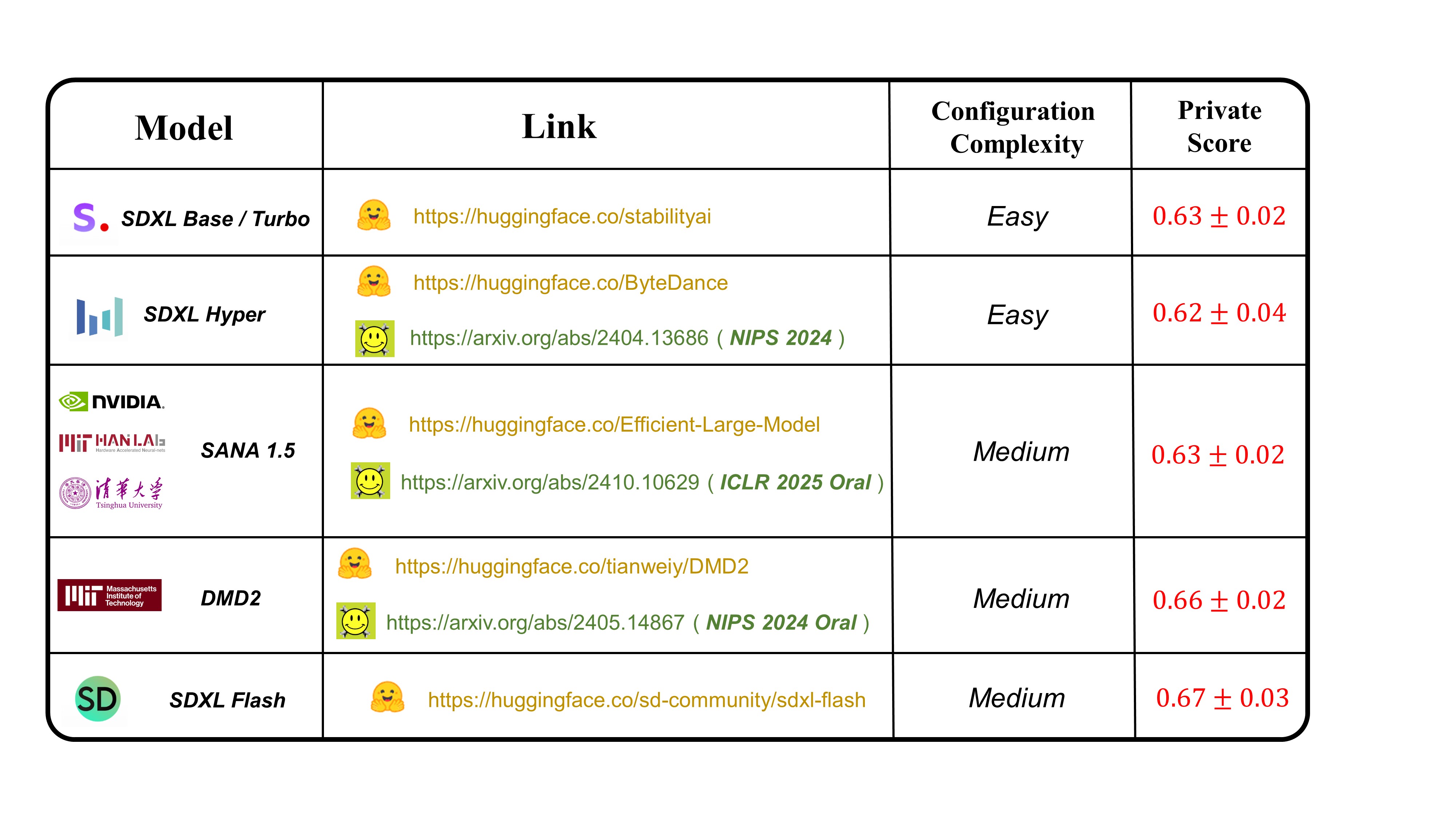\n\n---\n\n## Key Experimental Findings\n\nBelow is a summary of key experimental findings from the competition:\n\n### 1. **SDXL Base / Turbo and SDXL Hyper**\n- **User-friendly** and require minimal parameter tuning.\n- Facilitate a **lower barrier to entry**.\n- I adopted this approach during the mid-stage, which initially achieved a **high ranking** but declined towards the end.\n\n### 2. **SANA 1.5**\n- Performs well with **straightforward parameter settings**, yielding relatively high scores.\n- I hypothesize that **more advanced hyperparameter optimization** could further improve performance; however, time constraints precluded additional exploration.\n\n### 3. **DMD2 (4-step UNet generation)**\n- One of my final choices.\n- By utilizing the **demo code provided in the Model Card**, I achieved a high score with minimal effort.\n- **Simple parameter adjustments** resulted in an approximate **0.02 improvement**.\n- Further fine-tuning could yield even better results.\n- **Demonstrated considerable stability**.\n\n### 4. **SDXL Flash**\n- Also among my final submissions.\n- Achieved a score of **0.67 on the public leaderboard** using the demo code.\n- **Basic parameter tuning** allowed for further improvements.\n- **Limitation:** Instability—identical configurations often produced significantly different results across multiple submissions.\n\n---\n\n## Summary\n\nThroughout the competition, I experimented with a **variety of models and strategies**. While some models offered **ease of use and robust baseline performance**, others required more careful tuning to achieve optimal results. **Stability and reproducibility** emerged as important considerations, particularly in the final evaluation stage.", "votes": 10 } ], "complete": true, "source": "live", "fetched_at": "2026-10-20T09:10:51Z", "competition_id": 89659, "competition_slug": "drawing-with-llms", "team_id": 13668860, "solution_url": "/competitions/drawing-with-llms/writeups/sota-is-all-you-need-45th-place-solution" }